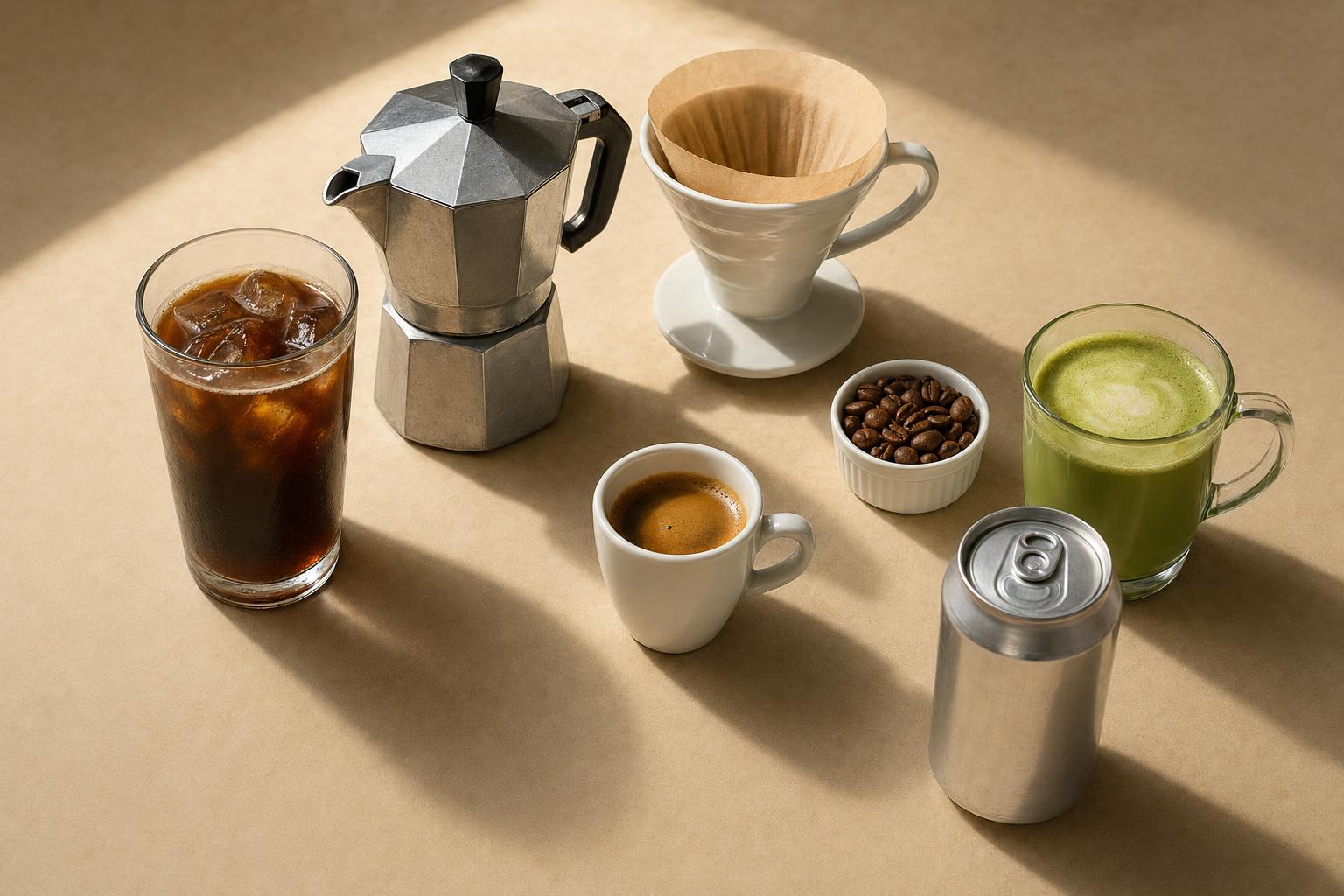
Caffeine content depends on the drink, the serving size, and the brand. A single espresso shot has about 64 mg, an 8-ounce cup of brewed coffee has roughly 95 mg, a 12-ounce cold brew often lands between 150 and 200 mg, and energy drinks range from 80 to 300 mg per container. Chain coffees vary more because recipes and serving sizes differ — Starbucks Blonde Roast at 16 oz is 360 mg, while McCafé brewed at the same size is 145 mg. The FDA says up to 400 mg of caffeine per day is generally safe for healthy adults, while clinicians typically advise pregnant people to stay under 200 mg. Use the calculator below to estimate caffeine by drink and size, compare it to daily limits, and total multiple drinks across your day. Values come from USDA FoodData Central, manufacturer nutrition data, and clearly-labeled RoastRanker brew tests.
Common Drinks at a Glance
The calculator above covers 80+ specific drinks with sourced data. The table below summarizes the most-asked-about caffeine values so you can scan quickly.
| Drink | Serving | Caffeine |
|---|---|---|
| Espresso (single shot) | 1 oz | 64 mg |
| Drip coffee | 8 oz | 95 mg |
| Drip coffee | 12 oz | 145 mg |
| Drip coffee | 16 oz | 195 mg |
| Cold brew (cafe) | 16 oz | 205 mg |
| Nitro cold brew | 16 oz | 280 mg |
| Decaf coffee | 8 oz | 3–15 mg |
| Latte (16 oz, 2 shots) | 16 oz | 128 mg |
| Americano (16 oz) | 16 oz | 225 mg |
| Starbucks Blonde Roast | 16 oz | 360 mg |
| Starbucks Pike Place | 16 oz | 310 mg |
| Dunkin’ Iced Coffee | 24 oz | 297 mg |
| McCafé brewed | 16 oz | 145 mg |
| Black tea | 8 oz | 47 mg |
| Green tea | 8 oz | 28 mg |
| Matcha latte (cafe) | 16 oz | 80 mg |
| Red Bull | 8.4 oz | 80 mg |
| Monster Energy | 16 oz | 160 mg |
| Bang Energy | 16 oz | 300 mg |
| 5-Hour Energy | 1.93 oz | 200 mg |
| Coca-Cola | 12 oz | 34 mg |
| Mountain Dew | 12 oz | 54 mg |
| Dark chocolate (70%) | 1 oz | 23 mg |
How Much Caffeine Is Safe Per Day?
The FDA does not regulate caffeine in food and beverages, but it has published guidance based on the available science. The headline numbers:
- Healthy adults: up to 400 mg per day is generally not associated with negative effects
- Pregnant or breastfeeding: the American College of Obstetricians and Gynecologists advises staying under 200 mg per day
- Adolescents (12–18): the American Academy of Pediatrics recommends no more than 100 mg per day
- Children under 12: the AAP recommends no caffeine at all
These limits assume caffeine is spread across the day. Consuming 1,200 mg in a short window — about 10 espresso shots back-to-back — has been linked in FDA reports to seizures and other serious effects. Pure caffeine powder or concentrated supplements are far more dangerous than equivalent amounts in coffee or tea because the caffeine hits the bloodstream faster and the dosing margin for error is small.
The calculator highlights both the 400 mg adult limit and the 200 mg pregnancy limit because those are the two thresholds most readers ask about. If you are tracking for a specific medical reason — heart condition, anxiety disorder, sleep issues — your doctor will usually recommend a tighter personal cap.
What Affects Caffeine Content
Five factors explain almost all of the variation between cups of the same drink:
- Bean variety. Robusta beans contain about twice the caffeine of arabica. Most specialty coffee is arabica; most commercial blends and espresso blends include robusta to add caffeine and crema stability.
- Roast level. Dark roasts lose a small amount of caffeine to heat and become less dense, so by volume they have slightly less caffeine. By weight the difference is negligible. The Starbucks Blonde-vs-Dark gap is mostly a brewing recipe difference, not a roast difference.
- Grind size and brew time. Finer grind and longer contact time extract more caffeine. French press at 4 minutes pulls more than drip at 4 minutes because of fuller immersion.
- Coffee-to-water ratio. A 1:15 ratio (specialty standard) extracts a different total caffeine than the 1:18 ratio of a typical home drip machine. Cold brew uses 1:4 to 1:8, which is why concentrate is so caffeinated.
- Serving size. A “cup” of coffee in nutrition data is 8 ounces. A coffeehouse “small” is 10–12 oz. A coffeehouse “large” is 20–32 oz. The same coffee can range from 95 mg to 400 mg depending on what gets poured.
Methodology and Data Sources
Every entry in the calculator names its source, gives a confidence level, and shows when we last verified the value.
Primary sources, in order of reliance:
- USDA FoodData Central — lab-measured values for generic categories (drip coffee, espresso, brewed tea, cocoa). Highest reliability for unbranded entries. Access here.
- Manufacturer nutrition data — for branded chain drinks (Starbucks, Dunkin’, Peet’s, McCafé, Tim Hortons, Dutch Bros, Caribou) and packaged drinks (Red Bull, Monster, Celsius, etc.). Posted by the brand and updated when recipes change.
- Center for Science in the Public Interest — caffeine chart used as a cross-check for less-documented categories (cold brew, French press, AeroPress).
- RoastRanker brew tests — for entries flagged “tested” we measured caffeine extraction in our own kitchen. Methodology is documented per entry. We treat these as medium-confidence and clearly label estimates.
- Peer-reviewed literature — used for matcha (McCusker et al., 2008) and a handful of less-commercialized drinks.
Confidence labels:
- High — value comes from a primary source, has been recently verified, and varies less than 10% in the wild. Most branded chain drinks live here.
- Medium — value is approximate. Either the source is older, the brewing method varies a lot in practice, or our own test is the source. Most generic brewed methods (French press, cold brew, pour over) live here.
- Low — used sparingly, only when no better data exists.
What we do not do:
- We do not invent linear ounce scaling for branded drinks. A “Tall” Starbucks latte and a “Grande” Starbucks latte both contain 1 shot of espresso, so caffeine doesn’t scale linearly with size. Our data uses the actual size-specific values, not extrapolation.
- We do not show false precision. A custom 14-oz pour over isn’t “168.42 mg” — it’s roughly 168 mg, marked as estimated.
- We do not treat ranges as point estimates. When USDA reports 95–165 mg per 8 oz brewed cup, the calculator shows the range and uses the midpoint.
The full data file is open in our GitHub repository — check src/data/caffeine/drinks.ts for the source list and confidence labels for every entry.
Caffeine Half-Life: When It Wears Off
Caffeine has a half-life of about 5 hours in healthy adults, meaning half of what you drank is still active 5 hours later. A 200 mg morning coffee at 8 a.m. leaves you with 100 mg active at 1 p.m. and 50 mg active at 6 p.m. — which is why an afternoon coffee disrupts sleep for many people even if it doesn’t feel like it.
Half-life varies dramatically by individual:
- Pregnancy: half-life roughly doubles, to about 10 hours
- Smoking: half-life decreases to roughly 3 hours (smokers process caffeine faster)
- Liver disease or certain medications (e.g., fluvoxamine, oral contraceptives): half-life can extend to 8–12 hours
- Genetic variation: the CYP1A2 enzyme that breaks down caffeine has fast and slow variants, and the gap between them is large
If you’re sensitive to caffeine and have trouble sleeping, the practical rule is to stop intake by 2 p.m. — that gives you about three half-lives before bedtime, leaving 12% of the dose active.
Mistakes the Calculator Helps You Avoid
A few common traps when estimating caffeine without data:
Assuming all espresso drinks are caffeinated by size. A Tall, Grande, and Venti latte at Starbucks all use 1–2 shots, not 1, 2, and 3. A Venti latte has the same caffeine as a Grande. Iced and americanos behave differently — their shot counts do scale with size.
Assuming dark roast = stronger. It tastes more intense but has slightly less caffeine. Use the calculator to confirm.
Counting decaf as zero. Decaf has 2–15 mg per cup. Three decafs across a sensitive afternoon can total 30+ mg.
Treating “energy drinks” as one category. Red Bull at 8.4 oz is 80 mg. Bang at 16 oz is 300 mg — almost four times more. The calculator separates them.
Ignoring chocolate. A 1-oz piece of 70% dark chocolate has 23 mg of caffeine. A baker’s chocolate brownie can have more caffeine than a soda.
Frequently Asked Questions
How much caffeine is too much in a day?
The FDA says up to 400 mg of caffeine per day is generally safe for healthy adults, which is about four 8-ounce cups of brewed coffee or two 16-ounce energy drinks. Pregnant or breastfeeding people are typically advised to stay under 200 mg per day. Children and adolescents should consume considerably less — the American Academy of Pediatrics recommends no caffeine for children under 12.
How much caffeine is in a cup of coffee?
An 8-ounce cup of brewed coffee contains about 95 mg of caffeine on average, with a typical range of 80 to 165 mg depending on the bean, roast, and brewing method. A 12-ounce cup is roughly 145 mg. Specialty coffeehouse coffees vary more — Starbucks Pike Place at 16 oz is 310 mg, while McCafé brewed at 16 oz is 145 mg.
Does dark roast coffee have more caffeine than light roast?
Slightly less, by volume — but more by weight. Dark roasting burns off some caffeine and reduces bean density, so a scoop of dark roast actually has fewer beans and slightly less caffeine than the same scoop of light roast. At Starbucks, blonde roast (180 mg per 8 oz) has more caffeine than dark roast (130 mg per 8 oz). The difference is small in practice.
How much caffeine is in a shot of espresso?
A standard 1-ounce espresso shot has about 64 mg of caffeine, according to USDA FoodData Central. Specialty cafes often pull stronger shots — Starbucks signature espresso is 75 mg per shot, Dunkin' espresso is around 118 mg per 1.5 oz shot, and Peet's runs about 80 mg per shot.
How accurate is this caffeine calculator?
Branded drinks (Starbucks, Dunkin', Monster, etc.) come from manufacturer nutrition data and are accurate within about 10%. Generic brewed coffee values come from USDA FoodData Central and the Center for Science in the Public Interest, which use lab-measured values. Custom-ounce estimates for generic drinks are based on per-ounce averages and clearly labeled as estimated. We list the source and confidence level for every entry.
Does decaf coffee have caffeine?
Yes. Decaf is required by FDA regulation to have at least 97% of the caffeine removed, which leaves a small amount. An 8-ounce cup of brewed decaf has 2 to 15 mg of caffeine, compared to 80 to 165 mg in regular coffee. Decaf espresso typically has about 8 mg per shot.
Why does cold brew have more caffeine than hot coffee?
Cold brew uses a much higher coffee-to-water ratio during brewing — typically 1:4 to 1:8 concentrate ratio versus 1:16 for drip coffee. Even after dilution, the resulting cup ends up more concentrated. A 16 oz Starbucks cold brew has 205 mg of caffeine, compared to 192 mg in 16 oz of standard drip.
Can I add multiple drinks to track my daily caffeine?
Yes. Click "+ Add to today" after calculating each drink, and the calculator stores your daily total in your browser. The running total appears in the bottom panel and shows how close you are to the FDA 400 mg safe limit. Your data stays on your device — nothing is sent to a server.
Related Reading
If you came here looking for a specific drink, these deeper guides cover the most common questions:
- How Much Caffeine Is in a Shot of Espresso? — full breakdown of espresso caffeine across cafes and roasts
- Espresso vs Coffee: A Direct Comparison — how the two stack up on caffeine, flavor, and serving size
- Light Roast vs Dark Roast: What’s the Difference? — including the caffeine question
- Pour Over Coffee Ratio Guide — how brew ratio affects strength