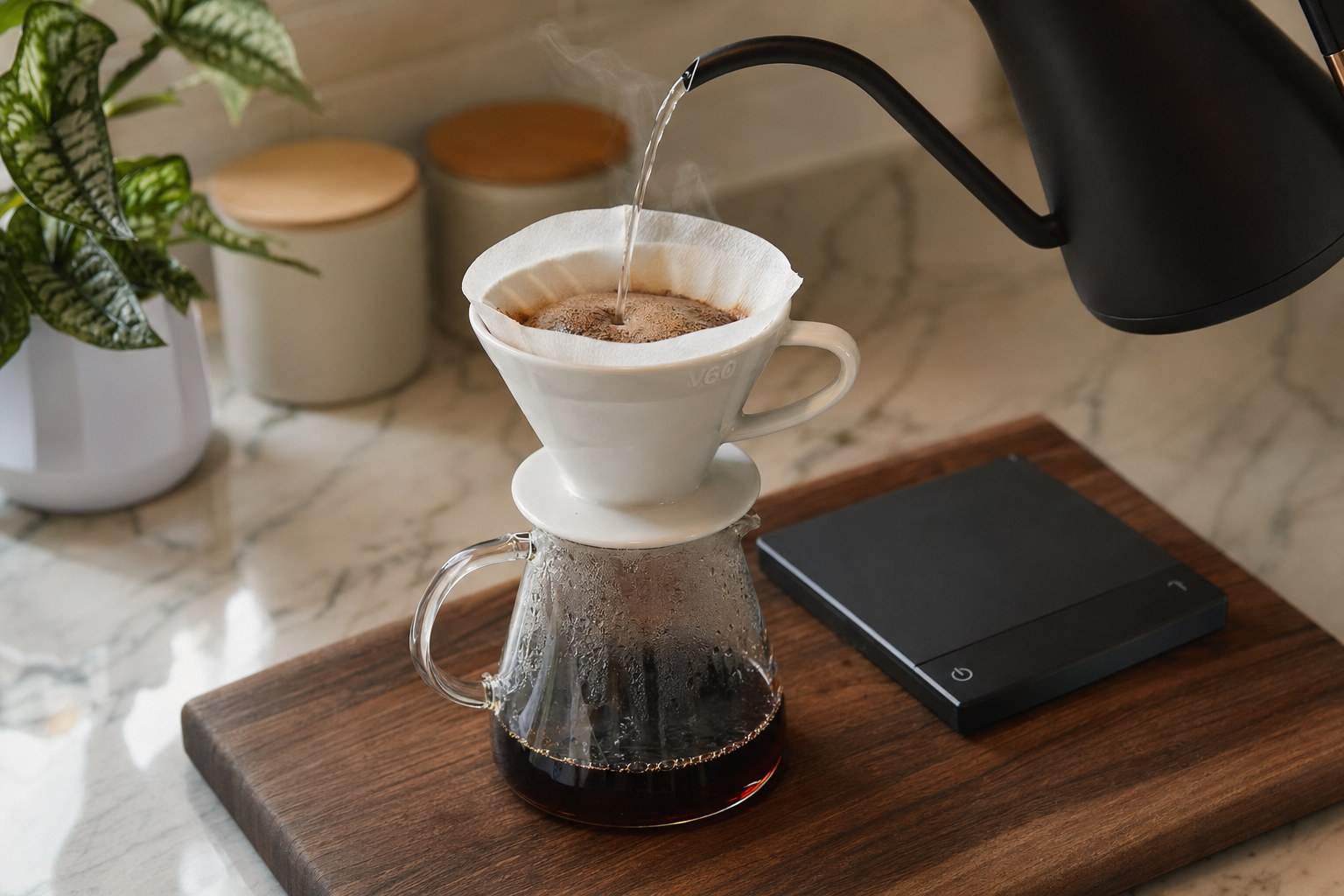
The right pour over coffee ratio is the one number that separates a clean, balanced cup from a brew that tastes weak, bitter, or just off. Most home brewers reach for tablespoons; baristas reach for a scale and a ratio. This guide gives you both: the consensus answer, and the gram values you actually need across the three dominant pour-over brewers.
The standard pour over coffee ratio is 1:16 by weight — 1 gram of coffee for every 16 grams of water. For a 12 oz mug (about 350 g brewed), that’s 22 g of coffee. For an 8 oz cup (240 g water), use 15 g. The working range across most specialty coffee is 1:15 to 1:17. Tighter ratios (1:14-1:15) suit dark roasts and stronger drinkers; open ratios (1:16.67-1:17) bring out clarity in light, single-origin coffees. Brewer choice nudges the ratio: Hario V60 brewers commonly run 1:16.67 (60 g per liter, James Hoffmann’s recipe), Chemex sits at 1:16 to 1:17 because the thick filter slows drainage, and the Kalita Wave’s flat bottom is happiest at 1:16. Lock one ratio per brewer, and adjust grind to taste.
The standard pour over coffee ratio
The three numbers worth memorizing are 1:15, 1:16, and 1:17. They cover almost every recipe published by reputable roasters and competition baristas. James Hoffmann, the 2007 World Barista Champion and Hario Europe ambassador, recommends 60 g of coffee per liter of water, which works out to 1:16.67. The Specialty Coffee Association’s Golden Cup standard is slightly looser at 55 g per liter, or roughly 1:18. Counter Culture publishes both V60 and Chemex recipes at 1:17. Pull these together and the consensus default lands at 1:16, with everything inside the 1:15-to-1:17 band considered fair game.
The math itself is one division. Decide your water weight, divide by your ratio, and that’s your coffee dose:
- 240 g water at 1:16 = 15 g coffee
- 320 g water at 1:16 = 20 g coffee
- 500 g water at 1:16.67 = 30 g coffee (Hoffmann’s Ultimate V60)
- 720 g water at 1:16 = 45 g coffee (Equator’s Chemex recipe)
A 0.1-gram scale is the only piece of gear you actually need to make this work. Tablespoon-based recipes float by 1-2 grams between roast levels, which is enough to push a clean cup into sour or bitter territory. Acaia’s Pearl Model S has a built-in pour-over mode and 0.1 g resolution; any kitchen scale with a tare button works fine to start.
Pour over ratio by brewer and serving size
Different filter geometries drain at different rates, which means the same ratio doesn’t taste the same across brewers. The chart below uses three serving sizes (1 cup, 2 cups, 4 cups) and matches each brewer to the ratio its specialty-coffee community has settled on. All values are coffee in grams.
| Brewer | 1 cup (240 g water) | 2 cups (480 g water) | 4 cups (960 g water) | Default ratio |
|---|---|---|---|---|
| Hario V60 | 14 g | 29 g | 58 g | 1:16.7 |
| Chemex | 15 g | 30 g | 60 g | 1:16 |
| Kalita Wave | 15 g | 30 g | 60 g | 1:16 |
Hario V60 runs slightly tighter on coffee because Hoffmann’s 60 g per liter (1:16.67) has become the de facto V60 standard. The conical shape and single large hole drain fast, which means the bed gets less contact time per gram of coffee, so a touch more water per gram preserves clarity in light roasts. Use the V60 size 01 for solo brews, 02 for 2 cups, and 03 for 4 cups.
Chemex lives at 1:16 in modern roaster recipes (Equator, Stumptown) and 1:17 in Counter Culture’s official guide. The thick bonded filter slows drainage to 4-5 minutes per brew, so opening the ratio slightly avoids over-extraction. Use the 3-cup Classic for solo brews, 6-cup for 2 cups, 8- or 10-cup for batches. Below 30 g of coffee, smaller Chemex sizes can choke on the slurry.
Kalita Wave is the most consistent of the three at 1:16 across roasters. Crema, Madcap, and Kaldi’s all publish 1:16 recipes. The flat bottom and three small holes give an even bed depth and predictable extraction, which is why beginners rank it as the most forgiving pour-over. Wave 155 covers 1-cup brews; Wave 185 handles 2-4 cups, though stalling can happen at 4-cup doses with finer grinds.
How to brew at 1:16 (with timing)
The example below uses a Hario V60 02 with 20 g of coffee and 320 g of water at 1:16. The same timing structure transfers to Kalita Wave 185 directly; for Chemex, add roughly 60-90 seconds to the total drawdown.
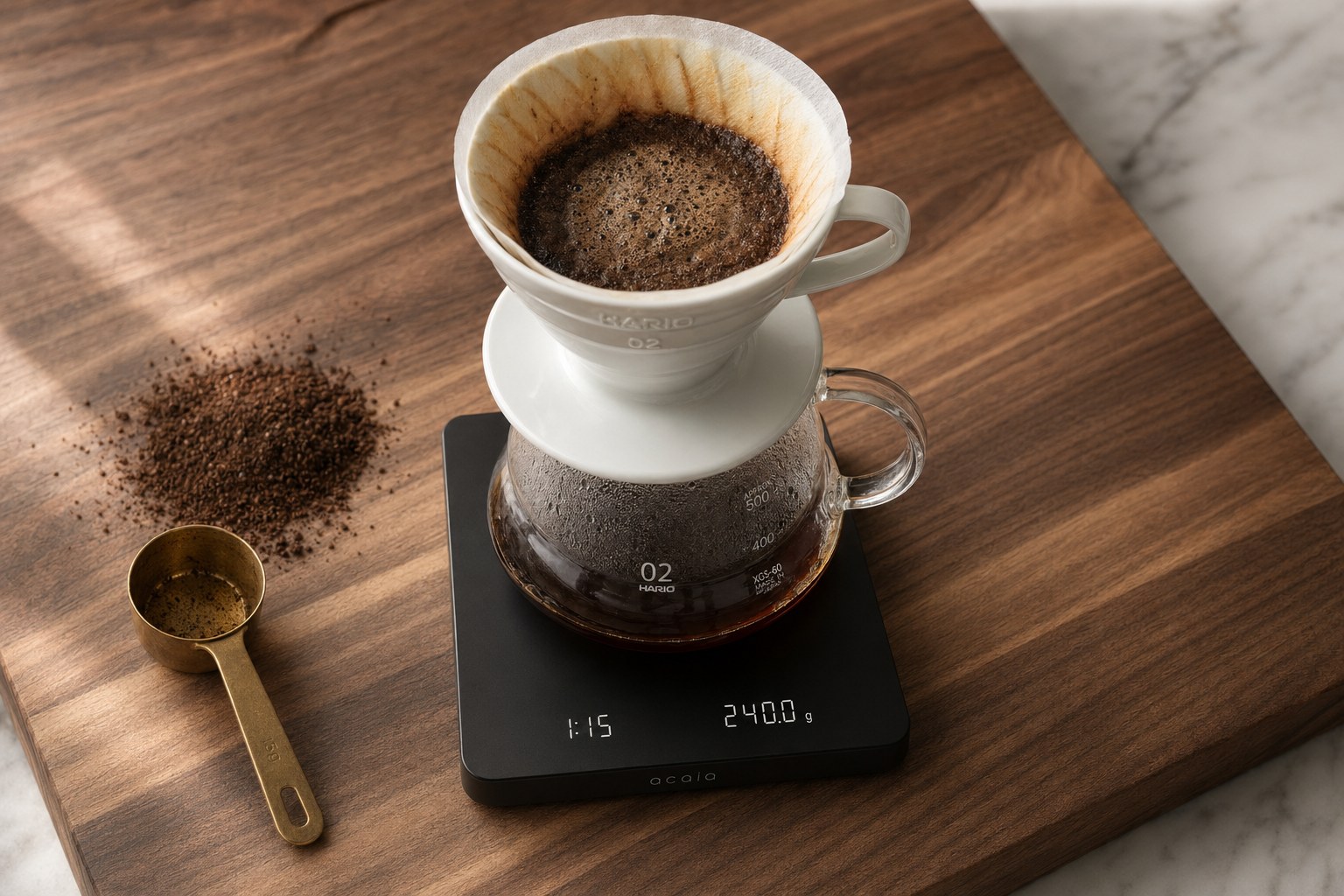
A 0.1 g scale with a built-in timer is the only piece of gear that turns guesswork into a repeatable ratio.
1. Prep (before timer starts). Boil water to 200°F (93°C). Place a paper filter, rinse with hot water, discard the rinse. Grind 20 g of coffee at medium-fine, close to table salt.
2. Bloom (0:00 to 0:45). Tare the scale with the dripper on top. Add the grounds, level the bed, start the timer. Pour 40 g of water (2x the coffee dose) in slow concentric circles. Swirl the dripper gently to wet all the grounds. Wait until 0:45.
3. First pour (0:45 to 1:15). Pour up to 200 g total in 30 seconds, keeping the stream centered and slow. The slurry should rise without hitting the top of the cone.
4. Second pour (1:15 to 1:45). Pour up to 320 g total. Use a slow spiral from the center outward, then back to center. Stop pouring when the scale hits 320.
5. Drawdown (1:45 to ~3:00). Give the dripper one final gentle swirl to flatten the bed. Walk away. The slurry should fully drain by 3:00 to 3:30 total.
6. Adjust by clock, not by ratio. Brew finished before 2:30? Grind one notch finer next time. Past 3:30? Coarsen one notch. Don’t change the ratio yet. Grind is the bigger lever.
For Chemex, hold the ratio steady and add 60-90 seconds to total brew time. For Kalita Wave 185, the timing matches the V60 within 15 seconds.
When to adjust your ratio
Lock 1:16 as your default and only move when one of three things is true.
Dark roast that tastes bitter or muddled. Tighten to 1:14 or 1:15. Dark beans extract faster and develop bitterness sooner; less water relative to coffee gives you the chocolate and caramel notes without pulling out the harsh end. Pull and Pour Coffee anchors 1:14-1:15 for dark roasts.
Light, single-origin coffee that tastes thin or sour. Open to 1:16.67 or 1:17. Light roasts are denser and harder to extract, so slightly more water per gram of coffee gives the slurry the contact time it needs to develop florals, citrus, and clarity. This is why Hoffmann’s 60 g/L (1:16.67) and Hedrick’s 1-2-1 method (1:17) both lean lighter.
Cup tastes weak no matter what. The fix is rarely the ratio. It’s grind. Coffee consultant Scott Rao’s rule: pick a sensible foundational recipe, lock it, and adjust only the grind when changing coffees. Tighten the ratio to 1:16 if you’re at 1:18, then grind one step finer. Don’t change three things at once or you can’t isolate the fix.
The other ratio decision is roast-specific bloom volume. The bloom is the first water added to wet the grounds and release CO₂. Standard guidance is 2x the coffee dose (40 g of bloom water for 20 g of coffee), held for 30-45 seconds. Hoffmann’s 1-cup V60 method uses a larger bloom (3.33x dose) for very small brews where surface area matters more.
If you’re rebuilding your pour-over from scratch, our moka pot vs French press comparison covers the next level up, for when you want a different brewing style entirely. For pour-over fundamentals, the Brewing Methods hub is the parent page for this guide.
Frequently Asked Questions
How much coffee for one cup of pour over?
For a standard 12 oz (350 g) mug, use 22 g of coffee at a 1:16 ratio. For an 8 oz (240 g) cup, use 15 g. The math is the water weight divided by 16. If you only have a tablespoon, Chemex's official guidance is 1 rounded tablespoon per 5 oz cup (about 10 g), but a 0.1-gram scale gives consistent results that volume measuring can't.
Is 1:15 too strong for pour over?
1:15 is on the strong end of the working range. It works well for dark roasts, blends, and drinkers who add milk, where the bigger body and lower-acidity profile shines. Light, single-origin coffees can taste muddled or one-dimensional at 1:15 because there isn't enough water to extract the delicate florals and citrus notes. Start at 1:16, then move to 1:15 if your daily-driver is dark.
Why does Chemex use a different ratio than V60?
Chemex's bonded paper filter is roughly three times thicker than a V60 filter, which slows drainage to 4-5 minutes versus 3-3:30 on a V60. That extra contact time can over-extract at tighter ratios, so most specialty roasters open the ratio slightly to 1:16 or 1:17. V60's faster flow tolerates 1:15 to 1:16.67 without the same risk. Different geometries, different ratios, same goal of a balanced cup.
How do I scale up for a 4-cup Chemex or V60?
Multiply both numbers by four. A 1-cup recipe of 15 g coffee and 240 g water becomes 60 g coffee and 960 g water at 1:16. Coarsen the grind by one step on your grinder to compensate for longer contact time at higher volume. Flow rate doesn't scale linearly. Use a Chemex 8-cup, V60 size 03, or split into two batches on a Kalita Wave 185.
What ratio does James Hoffmann recommend?
60 grams of coffee per liter of water, which works out to 1:16.67. Hoffmann uses this as a universal V60 starting point. His Ultimate V60 method is 30 g of coffee with 500 g of water, and his 1-cup V60 method is 15 g with 250 g. The ratio stays the same across batch sizes; only the bloom volume and pour count change.
What is the SCA Golden Cup ratio?
The Specialty Coffee Association's Golden Cup standard is 55 grams of coffee per liter of water, with a ±10% tolerance. That works out to roughly 1:18. The standard also targets 18-22% extraction yield and 1.15-1.35% total dissolved solids, brewed at 200°F (93°C) ± 5°. Many specialty roasters consider 1:18 slightly weak for pour-over and prefer 1:16 to 1:17.
Should I use a different ratio for light roast vs dark roast?
Yes. Dark roasts are less dense and extract faster, so 1:14 to 1:15 keeps the bitterness in check while bringing out chocolate and caramel notes. Light roasts are denser and need more contact time, so 1:16 to 1:17 (or even 1:18 for very light) helps develop clarity, acidity, and florals. Medium roasts default to 1:16. Adjust grind, not ratio, when switching between coffees of the same roast level.
Why does my pour over taste weak?
The two usual causes are a ratio that's too loose (1:18 or higher) or a grind that's too coarse, letting water rush through without extracting much. Tighten the ratio to 1:16 first, then grind one notch finer if it's still thin. Make sure your water is 200-205°F. Water under 195°F under-extracts even at correct ratios. Brew time under 2:30 on a V60 is another sign the grind is too coarse.