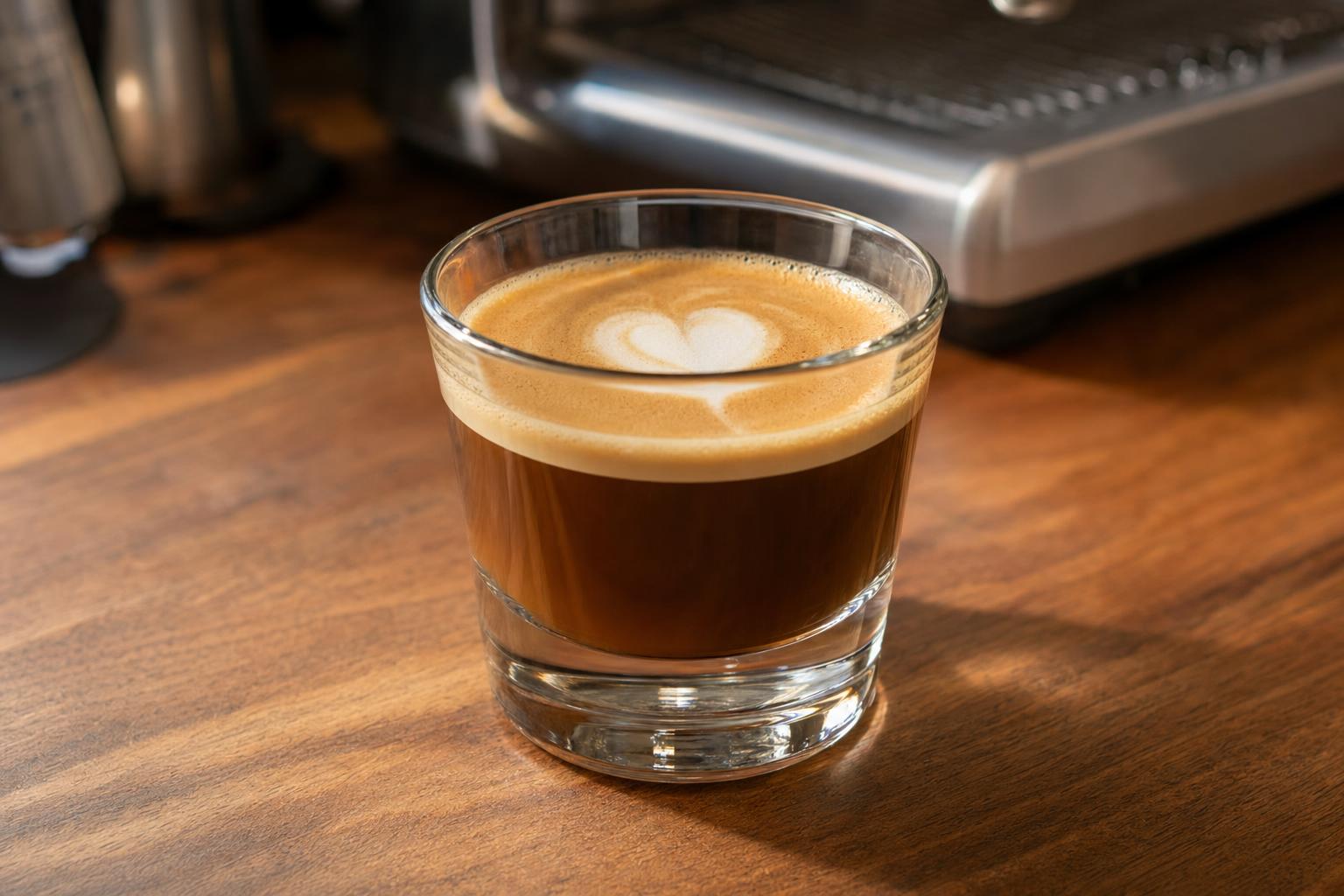
You ordered a cortado at a third-wave café, got a small glass of something dense and creamy, and walked out wondering what it actually was. Maybe the menu didn’t explain it. Maybe the barista said “Spanish drink, like a small flat white” and left it at that. The cortado is one of the most misunderstood drinks on the full espresso drinks menu, partly because chain shops blur the recipe and partly because it goes by two names in the US. This guide covers the rule that defines it, where it came from, how it stacks up against a latte, and how to make one at home.
A cortado is a 4 oz Spanish espresso drink built on a strict 1:1 ratio: 2 oz of espresso cut with 2 oz of lightly steamed milk. The name comes from the Spanish verb cortar (“to cut”), because the milk cuts the espresso’s intensity without burying its flavor. It originated in the Basque Country of northern Spain and crossed into US specialty coffee around 2005, when Blue Bottle Coffee in San Francisco started serving it in a 4.5 oz Libbey Gibraltar glass (model 15248). That’s why you’ll see “Gibraltar” and “cortado” used interchangeably at American cafés. The key difference from a latte: a cortado is espresso-forward (1:1 ratio, ~130 mg caffeine in 4 oz), while a latte is milk-forward (1:4 to 1:6 ratio, same caffeine spread across 12 oz or more).
The one rule that defines a cortado
The cortado is a 1:1 drink. Two ounces of double espresso, two ounces of steamed milk, four ounces total in the glass. Pour 1:2 and you’ve made a flat white. Pour 1:4 and you’ve made a small latte. The ratio is the rule, and the drink stops being a cortado the moment you break it.
The name says it plainly. Cortado comes from cortar, “to cut” in Spanish. The milk cuts the espresso’s intensity and acidity without masking what’s underneath. That’s why the milk texture matters as much as the volume. A proper cortado is finished with thin microfoam, not the thick froth of a cappuccino and not the flat steamed milk of a latte. The surface should look glossy, almost like wet paint.
Aaron Duckworth, a barista at Parisi Coffee in Kansas City, told Barista Magazine that the 1:1 ratio is what lets the bean speak: “The aromatic fruit bomb of an Ethiopian espresso will still be there.” Two ounces of milk softens the edge without erasing the origin character.
The corollary is that you can’t supersize a cortado. Ruben Pablo of Bungalow Coffee in Las Vegas put it bluntly to Barista Magazine: “When people want a larger version they disrupt this balance, and the easiest way to get to a larger drink is to add more milk.” The only way to scale up without breaking the drink would be to add more espresso proportionally, which defeats the whole point of asking for something bigger.
Cortado vs latte, flat white, cappuccino, and macchiato
Same espresso base, completely different drinks. What separates them is how much milk goes in and how that milk is textured. A double shot delivers roughly the same caffeine across all five drinks, but the experience changes dramatically between a 2 oz macchiato and a 12 oz latte.
| Drink | Size | Espresso:Milk Ratio | Caffeine (double shot) | Calories |
|---|---|---|---|---|
| Macchiato | 2–3 oz | 1:0.5 | ~130 mg | 15–20 cal |
| Cortado | 4 oz | 1:1 | ~130 mg | 45–65 cal |
| Flat White | 5–6 oz | 1:2 | ~120 mg | 80–110 cal |
| Cappuccino | 5–6 oz | 1:1:1 (thirds) | ~130 mg | 80–120 cal |
| Latte | 10–12 oz | 1:4–6 | ~130 mg | 150–250 cal |
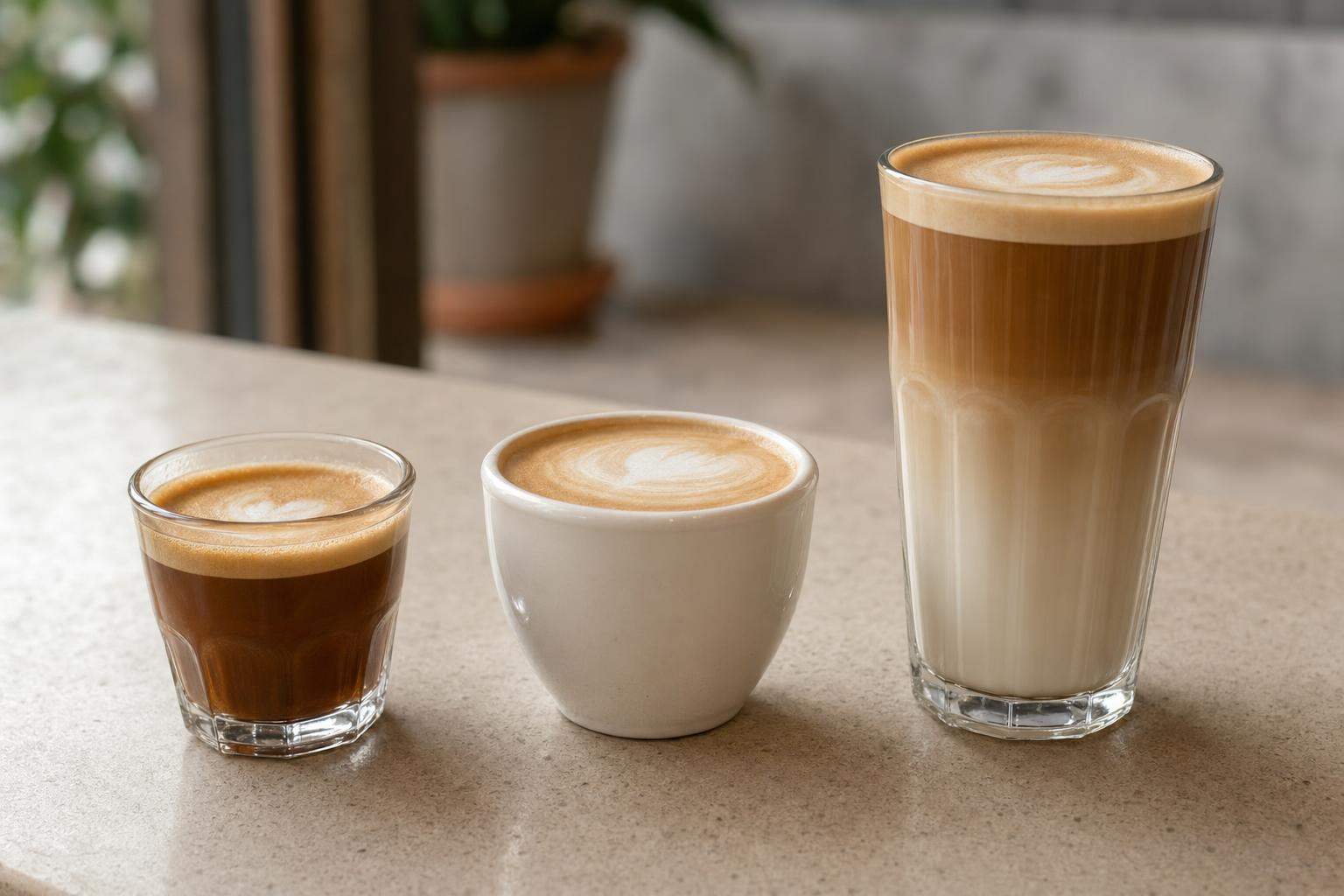
Left to right: cortado (4 oz), flat white (5-6 oz), latte (12 oz). The size difference explains the ratio difference.
The cortado and the flat white are the closest neighbors. Both treat the espresso as the lead, both use minimal foam, both fit in a small vessel. The flat white just adds another two ounces of milk and a richer body. If you’re learning the cortado by feel, the easiest reference point is “a flat white minus the extra milk.” For the wider field of café drinks beyond the espresso family, our breakdown of types of coffee drinks shows where each one sits on the spectrum.
The Gibraltar: how a San Francisco café gave the cortado its American name
Around 2005, an employee at Blue Bottle Coffee in San Francisco named Steve Ford started serving cortados off-menu in a 4.5 oz rock glass made by Libbey Glass Company. The glass was called the Gibraltar (model 15248), and the name stuck to the drink. Word spread through baristas, regulars carried it across the city, Ritual Coffee Roasters and other third-wave shops picked it up, and “Gibraltar” became the default US synonym for cortado.
Today the Libbey Gibraltar is still the canonical vessel for the drink in American specialty coffee. A two-pack runs about $16, the DuraTuff treatment makes it dishwasher safe and resistant to thermal shock, and the 4.5 oz volume leaves exactly the right headspace for a 4 oz pour. If you’re recreating the café experience at home, the glass is the cheapest part of the setup.
The Spanish original runs even more espresso-heavy than the US version. Nino Tusell, owner of Tusell Tostadores in Barcelona, told Perfect Daily Grind: “In Spain, a cortado is one shot of espresso with a little milk. [It] could be a ratio of 1:1 or 1:0.5.” The 1:0.5 traditional Basque preparation is closer to a wet macchiato than what most Americans expect.
Two close relatives worth naming: the cortadito is the Cuban variation, made with sweetened condensed milk instead of steamed milk. The cortado condensada uses a mix of condensed and steamed milk. Both are sweeter and richer than the standard cortado, and both belong to a different lineage.
Cortado caffeine and calories: the numbers
A standard US cortado made with a double shot contains roughly 126 to 140 mg of caffeine. A traditional Spanish single-shot version lands at 63 to 70 mg. Per ounce, the cortado delivers about 31 to 35 mg, which is more caffeine per ounce than any other milk-based espresso drink. A 12 oz latte built on the same double shot has the same total caffeine spread across three times the liquid, so each sip lands softer.
On calories, a 4 oz cortado made with whole milk runs about 45 to 65 calories. The espresso contributes around 5, and 2 oz of whole milk adds 35 to 40. Skim drops the total to roughly 30 to 35. Oat pushes it up by 10 to 15 depending on the brand. Compare that to a 12 oz whole-milk latte at 150 to 250 calories and the cortado looks like a different category of drink entirely. For a deeper breakdown of how espresso caffeine varies by bean, dose, and roast, see how much caffeine is in a shot of espresso.
How to make a cortado at home
You need an espresso machine with a real steam wand. Pod machines and handheld frothers can’t produce the thin microfoam the drink calls for, and budget machines under $100 usually lack the pressure to extract a proper double shot. If you’re wondering why an espresso machine is required in the first place, the short answer is pressure: see espresso vs coffee for the full comparison with drip.
Our entry-level pick is the Breville Bambino (BES450BSS, $249.95 on Breville.com). ThermoJet heating reaches temperature in 3 seconds, the 54mm portafilter pulls at 9 bars, and the manual steam wand produces real microfoam at a 6.25-inch footprint. Pair it with a Baratza Encore burr grinder ($169) for consistent fine-grind espresso, a 12 oz stainless frothing pitcher ($12 to $20) sized right for the small milk volume, and the Libbey Gibraltar glass ($16 for a two-pack) to serve.
The recipe:
- Grind and dose. Grind 18 to 20g of coffee fine, distribute it evenly in the portafilter, and tamp level.
- Pull the double shot. Lock in and pull about 2 oz in 25 to 30 seconds. The shot should flow like warm honey, not gush and not drip.
- Prep the milk. Purge the steam wand briefly. Pour 2 oz of cold whole milk into the 12 oz pitcher.
- Steam to thin microfoam. Submerge the wand just under the surface and open the valve. Introduce air for only 1 to 2 seconds (you want a soft hiss, not a screaming bubble). Then drop the wand deeper to heat the milk without adding more foam. Stop at 130 to 150°F (55 to 65°C). Above 155°F the milk scorches and turns bitter.
- Integrate. Tap the pitcher firmly on the counter 2 to 3 times to pop large bubbles. Swirl for 10 to 15 seconds. The milk should look glossy, like wet paint, not whipped or fluffy.
- Pour. Aim for the center of the glass with a slow, steady stream. A thin cap of foam will settle on top. Drink immediately.
Pro tip: pre-warm the Gibraltar glass with hot water and dump it before you pull the shot. The drink is only 4 oz, and glass cools fast, so a warm vessel buys you a few extra minutes of correct serving temperature.
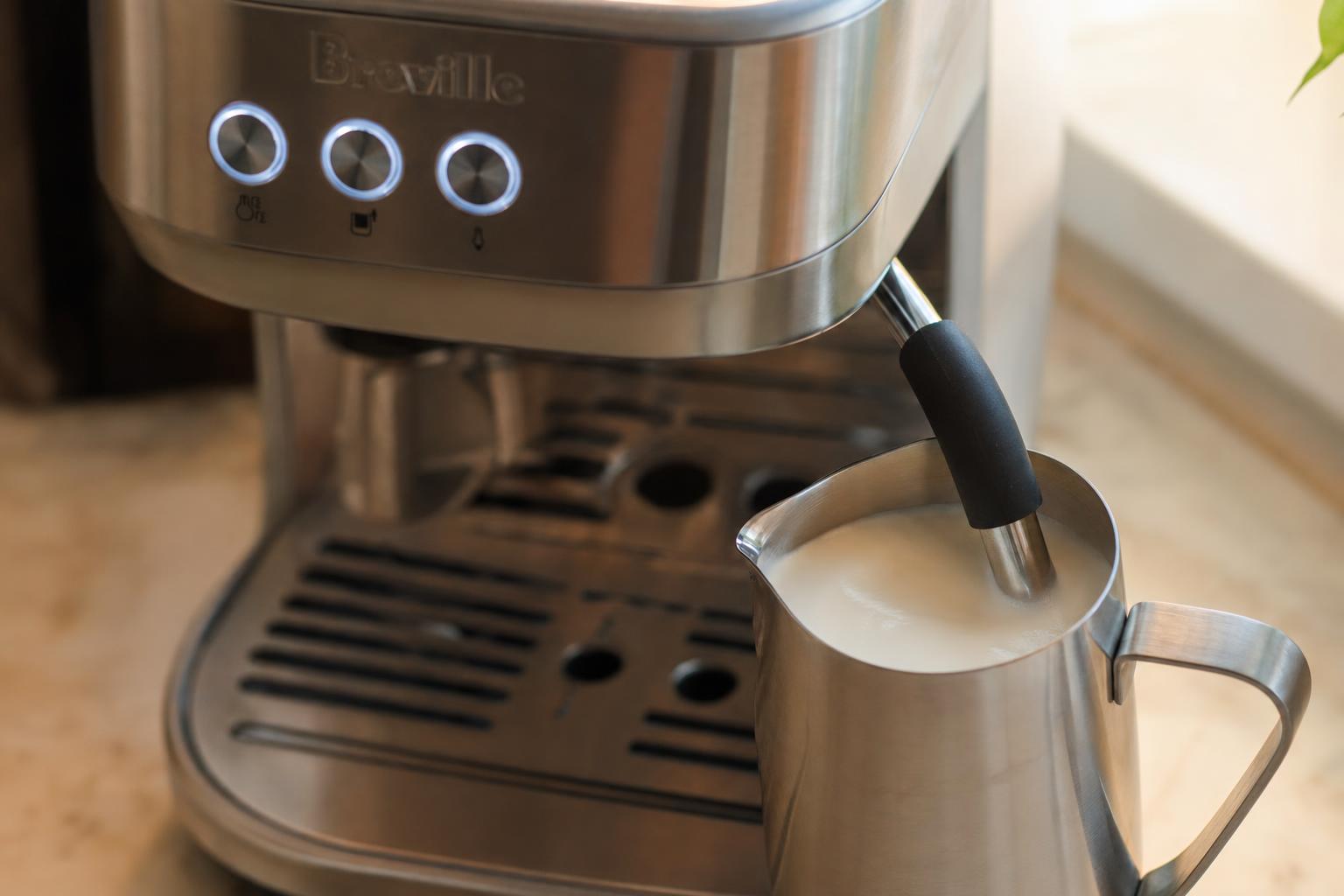
The Breville Bambino’s steam wand produces the thin microfoam a cortado requires — the key step that separates a proper cortado from a clumsily steamed one.
What a cortado tastes like and how to adjust it
A well-made cortado tastes smooth, balanced, and unmistakably coffee-forward. The espresso’s natural character comes through clearly because only 2 oz of milk is in the cup. Fruity Ethiopian beans stay fruity. Nutty Brazilian beans keep their toasted-almond quality. Chocolate-leaning Colombian or Sumatran espresso reads as cocoa, not bitterness. The milk softens the edge and adds body without erasing what’s underneath.
Bean choice matters more here than in milk-heavy drinks. Medium roasts work best at the 1:1 ratio because they preserve origin character without amplifying bitterness. Dark roasts can turn the small milk volume harsh and ashy. Light roasts can be exceptional if your espresso is well-dialed, with bright acidity and floral or stone-fruit notes lifting clean above the milk.
Customization is limited by design. Authentic preparation is unsweetened, since the lactose in the milk does the work. If you want sweetness, use a small amount of simple syrup rather than granulated, which doesn’t dissolve well in such a small drink. Oat milk is the best plant-based swap because it froths similarly to whole milk; almond and skim produce thinner results. Latte art is possible but limited: a simple heart fits, but the small surface makes anything more elaborate impractical.
Frequently Asked Questions
What is a cortado coffee?
A cortado is a small Spanish espresso drink made with equal parts espresso and lightly steamed milk, a 1:1 ratio resulting in a 4 oz drink. The name comes from cortar, meaning to cut, because the milk cuts through the espresso's intensity without masking its flavor. It originated in Spain's Basque Country and became popular in US specialty coffee shops around 2005, where it's sometimes called a Gibraltar.
What is the difference between a cortado and a latte?
The ratio. A cortado uses a strict 1:1 (2 oz espresso, 2 oz milk) for a 4 oz total drink. A latte uses 1:4 to 1:6 (1 to 2 oz espresso, 6 to 10 oz milk) for a 12 to 16 oz drink. The cortado is far more coffee-forward and lower in calories (~50 cal vs 150 to 250 cal). Latte milk carries some foam; cortado milk is thin microfoam only.
How much caffeine is in a cortado?
A standard cortado made with a double shot contains roughly 120 to 140 mg of caffeine. A single-shot Spanish-style version runs 60 to 70 mg. Because the drink is only 4 oz, the cortado delivers about 31 to 35 mg per ounce, more than a latte, cappuccino, or flat white made with the same shot.
What is a Gibraltar coffee?
A Gibraltar is the American name for a cortado, popularized at Blue Bottle Coffee in San Francisco around 2005 by an employee named Steve Ford. The name comes from the 4.5 oz Libbey Gibraltar glass (model 15248) the drink was served in. Today, Gibraltar and cortado are used interchangeably in US specialty coffee, though cortado is the internationally recognized term.
Is a cortado the same as a flat white?
No, though they're close relatives. A cortado is 1:1 (4 oz total). A flat white is 1:2 (5 to 6 oz total). The flat white has more milk, a richer body, and often uses ristretto shots for a sweeter base. The cortado is more espresso-forward, smaller, and lighter on calories. Think of a flat white as halfway between a cortado and a latte.
How do you make a cortado at home?
Pull a double shot of espresso (~2 oz) into a 4.5 oz glass. Steam 2 oz of whole milk to 130 to 150°F, introducing air for only 1 to 2 seconds to keep the foam thin. Pour the milk over the espresso at a 1:1 ratio. Total drink: 4 oz. Serve immediately. The Breville Bambino ($249.95) is the most-recommended entry-level machine for the job.
What milk is best for a cortado?
Whole cow's milk traditionally, because the fat content creates the smoothest microfoam and adds creaminess at low volume. Oat milk is the best plant-based substitute because it froths similarly to whole milk. Almond and skim work but produce thinner, less creamy results. The key is any milk that steams to a thin, velvety microfoam without going frothy.
How many calories in a cortado?
A standard 4 oz cortado with whole milk runs about 45 to 65 calories. The espresso contributes around 5. Two ounces of whole milk adds 35 to 40. Skim drops the total to roughly 30 to 35. Oat lands around 55 to 75 depending on the brand. By comparison, a 12 oz whole-milk latte sits at 150 to 250 calories.
What is the cortado ratio?
The defining cortado ratio is 1:1, equal parts espresso and steamed milk. For a standard home preparation: 2 oz espresso plus 2 oz steamed milk equals 4 oz total. This is what separates a cortado from a flat white (1:2) or a latte (1:4 to 1:6). Many chain shops blur the ratio, but a true cortado from a specialty café is always 1:1.
What does a cortado taste like?
Smooth, balanced, and boldly coffee-forward. The espresso's natural notes (fruity, nutty, or chocolatey depending on the bean) come through clearly because only 2 oz of milk is present. The milk softens bitterness and adds a subtle creaminess without taking over. A well-pulled cortado with quality beans tastes rich without being harsh, and the espresso character is far more legible than in any milk-heavier drink.