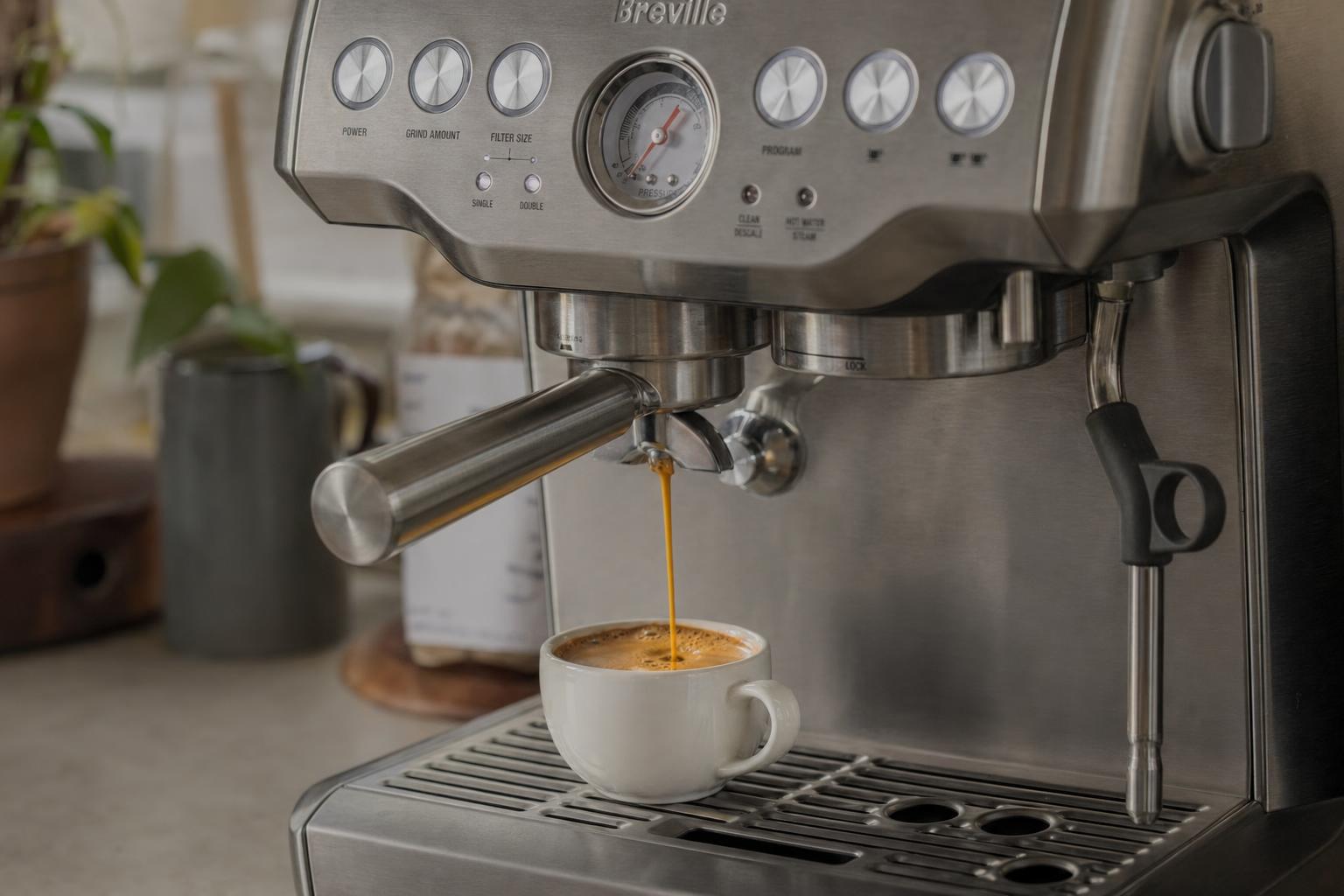
The portafilter is the part of an espresso machine you touch more than any other. You dose into it, tamp into it, lock it in, and pull every shot through it. Stock baskets ship loose-tolerance, lug positions vary between manufacturers, and a cold portafilter can wreck a shot before the pump ever starts. Beginners blame their grinder or their beans when the real bottleneck is sitting in their hand.
A portafilter is the removable handle assembly that holds ground coffee against the group head while the espresso machine forces pressurized hot water through the puck. It has three main parts: the handle (your grip), the body (the metal cup with locking lugs), and the filter basket (the perforated insert that holds the grounds). Three diameters dominate the home market: 51mm on De’Longhi Dedica machines, 54mm on Breville Barista series, and 58mm on commercial-style machines like the Gaggia Classic Pro, Rancilio Silvia, and every E61 group head. Baskets come in two flavors: pressurized (dual-wall, beginner-friendly, forgives bad grinders) and non-pressurized (single-wall, demands a real burr grinder, delivers café-quality shots).
Portafilter anatomy: what’s inside the handle
Pull a portafilter apart and there are four parts that matter, each affecting how a shot behaves.
The handle is the grip you hold. Entry-level machines use heat-resistant plastic. Prosumer machines step up to walnut or rosewood, which stays cooler and feels more solid in the hand. The handle is mostly aesthetic, but on long sessions wood is easier on your palm.
The body is the metal cup the basket sits inside. Chrome-plated brass is the common build, retaining heat well and resisting corrosion. The Rancilio Silvia ships with a chrome-plated brass body and ergonomic handle, the standard configuration on commercial-style home machines. The Gaggia Classic Pro uses stainless steel instead. Both materials work; brass holds temperature longer, stainless heats up faster.
The spring clip is a thin C-shaped ring inside the body that retains the basket. To remove the basket, pry it out from the underside; to reinstall, press it down until the clip snaps over the rim.
The filter basket is the removable perforated metal cup that actually holds the grounds. This is the single most important component for shot quality, and it’s the one part you can swap independently of the rest of the portafilter.
Finally, the lugs (locking tabs) are the metal tabs sticking out from the body that twist into the group head channel. Lug position is not standardized. A 58mm portafilter from one brand may not fit a 58mm machine from another, which becomes critical when shopping for aftermarket bodies.
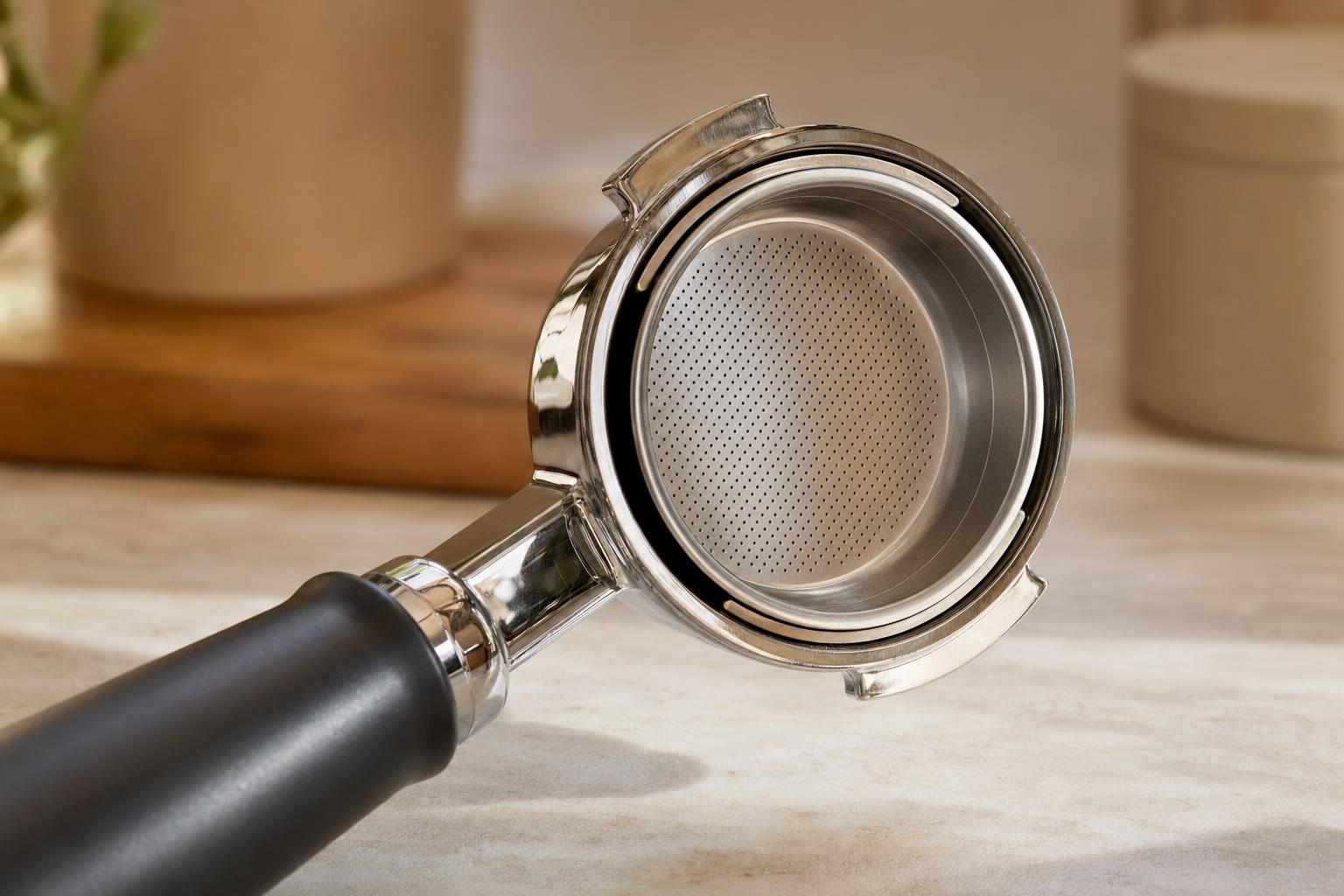
Gaggia Classic Pro bottomless portafilter with basket exposed — the spring clip (C-ring) is visible inside the body rim.
Portafilter sizes: 51mm, 54mm, and 58mm explained
Portafilter size is determined by your machine, not by you. The diameter difference matters more than the numbers suggest: a 7mm gap between 51mm and 58mm produces a roughly 25% taller puck at the same dose (per Craft Coffee Spot), which changes extraction behavior, flow path length, and how forgiving the puck is to imperfect tamping.
| Diameter | Common Machines | Aftermarket Basket Support |
|---|---|---|
| 49mm | La Pavoni lever machines, select older entry-level machines | Very limited, almost no aftermarket baskets available |
| 51mm | De'Longhi Dedica (EC685, EC758, EC680), Icona Vintage, ECP series | Limited, some third-party options, no VST/IMS/Pullman |
| 53mm | Older Rancilio/Gaggia models, Luca A53 Mini | Limited, niche market, few precision basket options |
| 54mm | Breville Barista Express, Barista Pro, Barista Touch, Bambino Plus, Infuser | Moderate, Breville-specific aftermarket, no VST/IMS/Pullman |
| 58mm | Gaggia Classic Pro, Rancilio Silvia, La Marzocco Linea Mini/Micra, all E61 group heads (Rocket, ECM, Bezzera, Lelit), Flair 58, Breville Dual Boiler/Oracle Touch | Excellent, VST ($35), IMS (~$30), Pullman (~$90 to 110) all available |
Even among 58mm machines, lug position varies between manufacturers (typically 6 o’clock vs 7 o’clock orientation), so verify lug compatibility before buying an aftermarket portafilter body.
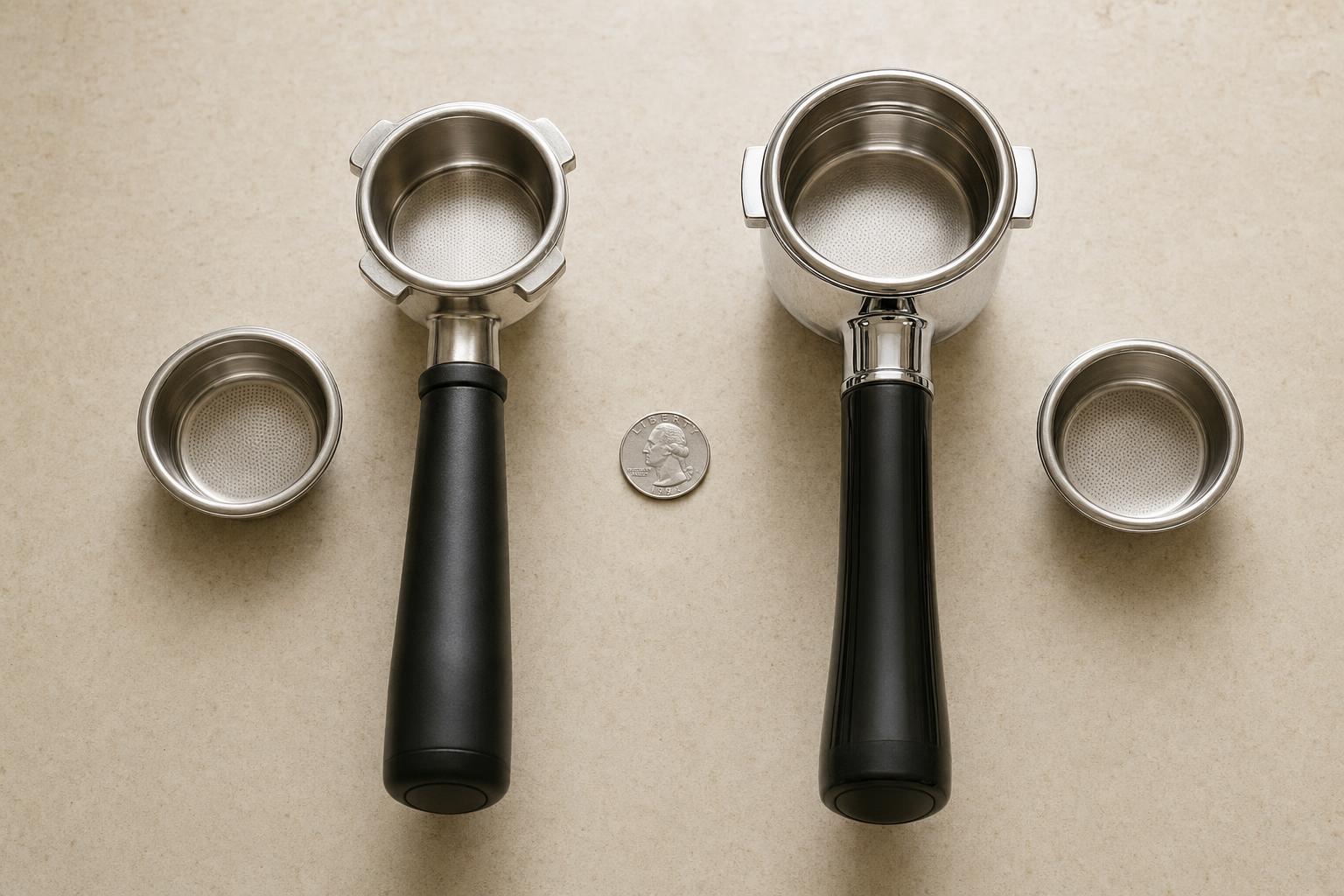
Left: 54mm Breville portafilter. Right: 58mm Gaggia Classic Pro portafilter. US quarter included for scale.
Pressurized vs. non-pressurized: which basket should you use?
The basket inside your portafilter is either pressurized or non-pressurized, and this choice changes everything about how your shots behave.
A pressurized basket (also called dual-wall) has two walls. The inner wall is perforated with the holes coffee passes through; the outer wall has a single small output hole that creates artificial back-pressure on the way out. That back-pressure compensates for inconsistent grind, sloppy distribution, and uneven tamping. The shot looks correct (you get crema, you get flow) even when the input variables are wrong. Pressurized baskets are the right choice if you’re using pre-ground coffee or a cheap blade grinder, because they prevent the shot from gushing through in three seconds.
A non-pressurized basket (single-wall) has one perforated wall. All the back-pressure comes from the pump pushing against a properly tamped puck of consistently-ground coffee. There’s no margin for error. With a quality burr grinder and good technique, single-wall baskets produce noticeably better espresso: more flavor clarity, more body, denser crema. Without those inputs, they fail loudly.
- Enables professional-quality extraction with proper grind, dose, and tamp
- Provides direct feedback, extraction quality reflects your technique
- Superior flavor clarity, body, and crema when used correctly
- Compatible with precision aftermarket upgrades (VST, IMS, Pullman)
- Requires a quality burr grinder, inconsistent grind causes under-extracted or channeled shots
- Steep learning curve: distribution, tamping, and dose must all be correct
- Messy with imperfect technique if the puck channels severely
If you don’t yet own a burr grinder, stay with the pressurized basket. Once you have a dedicated burr grinder (even an entry-level Baratza Encore), switch to non-pressurized and don’t look back. Beginners who switch without the right grinder run into the “sprinkler effect”: at nine bars of pump pressure, channels in a poorly-prepared puck spray grounds and water sideways through the bottomless portafilter or out the spouts in irregular streams. It’s not a basket problem. It’s a grinder and technique problem the basket exposes.
Spouted vs. bottomless (naked) portafilters
A spouted portafilter has one or two metal spouts on the underside that funnel espresso into your cup. This is the standard factory configuration on every machine. Single-spout versions direct flow into one cup; double-spout versions split the flow into two cups simultaneously. Spouts hide the underside of the basket from view, so you can’t see what the extraction is actually doing.
A bottomless portafilter (also called naked) has the underside of the basket fully exposed. Espresso pours directly out of the basket holes in front of you. James Hoffmann puts it directly: “Using a bottomless portafilter is a great way to assess channeling while making espresso. Channeling occurs when water finds an easier pathway through the puck instead of flowing through the entire bed evenly, caused by uneven grind distribution or an uneven tamp.”
A perfect shot from a bottomless portafilter pours as a single tight stream that pulls inward into a “mouse tail” before dripping into the cup. A bad shot sprays, splits into two streams, or shoots a jet sideways. Lance Hedrick’s blunter take (“NAKED PORTAFILTERS ARE LIARS”) is the necessary nuance: a beautiful pour can still taste mediocre, and a slightly-spraying pour can still taste excellent. Visual feedback is useful, not definitive.
Bottomless portafilters are also easier to clean. Spouted portafilters trap coffee oils inside their internal channels, which build up over weeks and turn rancid. There’s nothing to trap on a bottomless. When tracking shot-level outcomes like extraction yield or how much caffeine ends up in your espresso shot, the bottomless gives you cleaner data because nothing is sticking to old residue between pulls.
Aftermarket precision baskets: when to upgrade to VST, IMS, or Pullman
Stock OEM baskets are the weakest link in most home espresso setups. In a controlled 40-shot comparison, VST precision baskets produced less than half the shot-to-shot variability of stock OEM baskets and eliminated heavy channeling entirely (Clive Coffee). The reason is hole geometry: stock baskets have inconsistent hole sizes, uneven hole spacing, and rough laser-cut edges that disrupt flow.
Clive Coffee’s takeaway is direct: “All the procedure and training in the world is never going to overcome the limits of an imprecise basket.”
Three brands dominate the precision-basket market.
VST ($35) is the gold standard. Every basket has its hole array optically measured to ±30 microns and ships with an individualized QC report and serial number. The 18g standard is the most common, but VST also makes 7g, 15g, 20g, 22g, and 25g versions. Walls are 20% thicker than typical baskets, which adds rigidity and improves tamp feel.
IMS Competition (~$30) uses 715 micro-pitch holes laid out in a curved bottom pattern that redirects flow toward the center of the basket to fight channeling. The design is ridgeless (no internal lip the puck can hang on). IMS is Italian-manufactured, with an optional NanoTec coating that releases the puck cleanly during knock-out.
Pullman 876 (~$90 to 110 USD) uses 876 laser-cut holes optimized for the Pullman BigStep tamper, which has a contoured base that matches the basket’s internal geometry. Australian-made, individually measured, and individually approved before shipping. The premium price reflects the manufacturing tolerance.
One compatibility note decides this for most home baristas: all three are 58mm only. There is no precision-basket upgrade path for 54mm Breville machines, 51mm De’Longhi Dedica, or anything smaller. This is one of the strongest practical arguments for stepping up to a 58mm machine when you’re ready to invest. The upgrade ceiling is dramatically higher.
Using and maintaining your portafilter
Inserting and locking
Start with the handle pointing roughly at 7 to 8 o’clock, lugs engaged in the group head channel, then rotate clockwise to 5 to 6 o’clock (handle straight toward you) with firm controlled torque. Wipe the basket rim with your palm before locking in to clear stray grounds that prevent a clean gasket seal. Do not insert with a sudden knocking motion. The impact disturbs the tamped puck and causes channeling even with a perfect tamp. Start the shot within seconds of locking in to minimize temperature loss into the puck.
The cold portafilter problem
A cold portafilter acts as a heat sink and can drop brew water temperature by up to 10°C (18°F) before water reaches the grounds (Papel Espresso). The Specialty Coffee Association identifies 92°C to 96°C (198°F to 205°F) as the ideal espresso brew temperature range, so a 10°C drop puts you well below the floor. Leaving the empty portafilter locked in the group head during the full 15 to 20 minute warm-up prevents this. Every espresso machine setup we’ve tested shows the same cold-portafilter effect, which is why thermal equilibration matters for espresso brewing in general, not just budget machines.
Cleaning schedule
Daily: rinse the basket under hot water immediately after pulling a shot and wipe dry with a microfiber towel. Every 2 to 4 weeks: remove the basket from the body and soak it in hot water with espresso cleaning solution (Cafetto EVO is the industry standard) for 15 to 30 minutes. Warning signs that cleaning is overdue: stale or rancid smell from the basket, bitter flat shots despite fresh beans, visible dark oil residue around the holes, or shots pulling faster than usual with no grind changes. For pressurized baskets specifically, the single output hole in the outer wall clogs with dried coffee oils quickly. A partially blocked hole is the most common reason crema disappears on a dual-wall basket, and it gets blamed on technique long before anyone thinks to clean the basket.
Frequently Asked Questions
What size portafilter do I need?
Size is determined by your machine, not your preference. 51mm fits the De'Longhi Dedica series (EC685, EC758, EC680). 54mm fits the Breville/Sage ecosystem (Barista Express, Barista Pro, Bambino Plus, Infuser). 58mm fits the Gaggia Classic Pro, Rancilio Silvia, La Marzocco Linea Mini, and every E61 group head. Always verify the diameter on your machine spec sheet before buying.
Can I use any portafilter with any espresso machine?
No. Portafilters are machine-specific. Compatibility requires matching basket diameter plus matching lug shape and lug position, which varies between manufacturers. Even two 58mm portafilters from different brands may not be interchangeable. Always verify the aftermarket portafilter is listed as compatible with your machine model.
What is a naked portafilter used for?
A naked (bottomless) portafilter exposes the basket underside so you can see channeling in real time. It is also easier to clean since there are no internal spout passages to trap coffee oils. Bottomless portafilters are typically aftermarket purchases priced $40 to $120.
How often should I clean my portafilter?
Rinse the basket under hot water after every shot. Do a full soak in espresso cleaning solution every 2 to 4 weeks. Warning signs: rancid smell, bitter flat shots despite fresh beans, dark oil residue around the holes, or shots running faster than expected without any grind change.
Do aftermarket precision baskets like VST or IMS actually make a difference?
Yes. Clive Coffee's 40-shot test showed VST baskets produced less than half the variability of stock OEM baskets and eliminated heavy channeling entirely. Both VST ($35) and IMS Competition (~$30) are worthwhile upgrades once your technique is established. Precision baskets are 58mm only — no upgrade path for 54mm or smaller machines.
Should I leave my portafilter in the group head when the machine is warming up?
Yes. A cold portafilter can drop brew water temperature by up to 10°C (18°F), putting you below the SCA-recommended 92°C to 96°C range. Lock the empty portafilter into the group head during the full 15 to 20 minute warm-up. The ready light comes on before the portafilter is fully equilibrated, so the light is not a reliable signal.