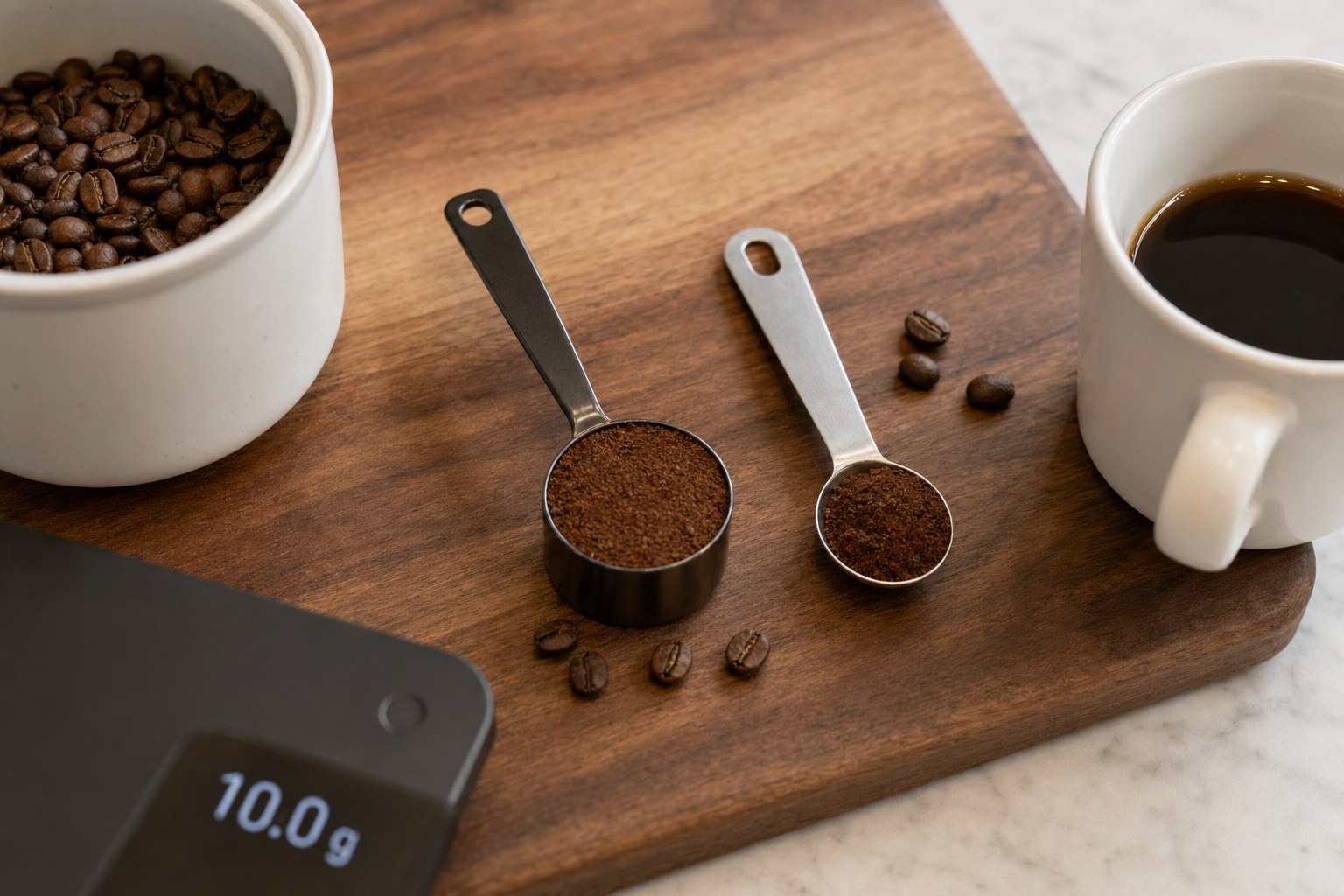
If you bought a coffee maker, glanced at the manual, and now you’re staring at the bag wondering how many spoons go in, the answer is short. One to two tablespoons per cup. The longer answer is what cup actually means, why scoops aren’t tablespoons, and when to ditch the spoon entirely and weigh your beans.
Use 1 to 2 tablespoons of ground coffee per 6 oz cup of water — 2 tablespoons is the standard. That’s roughly 10 grams of coffee per 6 oz, matching the Specialty Coffee Association’s 55 g per liter Golden Cup ratio. A standard coffee scoop holds 2 tablespoons. So 1 scoop = 1 cup. For an 8 oz mug, use 2 tablespoons (or about 1 slightly heaped scoop). For a 12 oz mug, use 3 tablespoons. For a full 12-cup pot (72 oz), use 12 to 24 tablespoons depending on how strong you like it. The “cup” your coffee maker counts is 6 oz, not the 8 oz US measuring cup. Tablespoons are accurate enough for drip coffee but vary by 3 grams depending on grind and roast — switch to a gram scale if you brew pour-over or espresso.
The chart: tablespoons by cup and mug size
The first source of confusion is the word cup. A coffee-maker cup is 6 oz. A US measuring cup is 8 oz. Most mugs are 8-12 oz. Three different “cups” in the same kitchen. The chart below converts between them so you don’t have to do the math at 6 a.m.
| Brew size | Water (oz) | Tablespoons | Standard scoops (2 tbsp) | Grams (at 1:15) |
|---|---|---|---|---|
| 1 coffee-maker cup | 6 oz | 2 tbsp | 1 scoop | 10 g |
| 1 small mug | 8 oz | 2-3 tbsp | 1-1.5 scoops | 15 g |
| 1 standard mug | 10 oz | 3 tbsp | 1.5 scoops | 18 g |
| 1 large mug | 12 oz | 3-4 tbsp | 2 scoops | 22 g |
| 1 travel mug | 16 oz | 5 tbsp | 2.5 scoops | 30 g |
| 4-cup carafe | 24 oz | 8 tbsp | 4 scoops | 45 g |
| 8-cup carafe | 48 oz | 16 tbsp | 8 scoops | 90 g |
| 12-cup pot (full) | 72 oz | 24 tbsp | 12 scoops | 135 g |
The grams column uses a 1:15 ratio (a touch stronger than SCA Golden Cup’s 1:18) because it lines up cleanly with the 2-tablespoon-per-6-oz tradition most coffee-maker manuals print. If you want a slightly lighter brew, drop to 1.5 tablespoons per 6 oz cup. If you want stronger, go to 2.5.
What a “cup” actually means in coffee land
Coffee-maker manufacturers settled on 6 fluid ounces as one cup decades ago. The number predates modern mug sizing and never updated. So when you see a 12-cup coffee maker, it brews 72 oz total, which fills:
- Six 12 oz mugs
- Eight 8 oz mugs
- Four 16 oz travel mugs
- Twelve old-school 6 oz teacups (the kind almost no one uses anymore)
When you scale your tablespoons up, scale by 6 oz coffee-maker cups, not by physical mugs. If your morning ritual is two 12 oz mugs, that’s four 6 oz cups of brew, which means 8 tablespoons of coffee, not 4. This is the single most common reason home-brewed coffee tastes weak. The brewer is set to make 4 mugs but the user dosed for 4 cups, leaving the actual ratio at half-strength.
Scoops vs tablespoons vs teaspoons
A standard coffee scoop holds 2 tablespoons (about 10 g of ground coffee). The shorthand stays convenient: 1 scoop equals 1 (6 oz) cup. Manufacturers picked the 2-tablespoon size because it pairs cleanly with the SCA Golden Cup ratio.
Some scoops are smaller. There’s a 1-tablespoon “barista” scoop that’s roughly the size of a soup spoon. If yours looks small, level a tablespoon of water into it and check that the volumes match before you trust the scoop.
Teaspoons are not the right tool for measuring coffee. 3 teaspoons = 1 tablespoon, so for a 6 oz cup you’d be measuring 6 teaspoons. The variance gets worse the smaller your spoon, and you’re up to 36 teaspoons for a full 12-cup pot. Coffee scoops or tablespoons are faster and more consistent.
When tablespoons stop being good enough
Tablespoons work for daily drip coffee because the variance averages out across multiple spoonfuls and the brew method is forgiving. They stop working when you switch to:
- Pour-over (Hario V60, Chemex, Kalita Wave). The ratio matters more, and a 3-gram swing per tablespoon can push a clean cup into sour or bitter. The pour over coffee ratio guide covers this in gram detail.
- Espresso. A standard double shot uses 18 g (about 3.5 level tablespoons). Off by half a tablespoon and the shot pulls under or over.
- AeroPress and French press. Less sensitive than pour-over but still reward gram precision.
The fix in all three cases is a 0.1-gram kitchen scale. They cost $15-20, last forever, and turn coffee from guesswork into repeatable brewing. Acaia’s Pearl is overkill for drip coffee but worth it for serious pour-over.
A level tablespoon of ground coffee weighs:
- 4.5-5 g for dark roasts (less dense, fluffier grind)
- 5-5.5 g for medium roasts (the most common case)
- 5.5-6 g for light roasts (denser beans, packs tighter)
- 6.5-7.5 g when measured heaped, regardless of roast
That spread is why a recipe written in tablespoons can taste different on a different bag of coffee. Same scoop, different mass, different cup.
Adjusting strength without buying gear
If you’re sticking with the spoon, three rules of thumb keep you in the right zone:
Coffee tastes weak. Add half a tablespoon per 6 oz cup next brew. Don’t double the dose all at once. Half-tablespoon increments give you finer control.
Coffee tastes bitter or harsh. Don’t reach for the scoop first. Coarsen the grind (move one notch toward “French press” on a grinder, or buy a slightly coarser pre-ground bag). Bitterness usually comes from over-extraction, not over-dosing. If grinding doesn’t fix it, then drop a half-tablespoon.
Coffee tastes flat or muted. Use a fresh bag. Coffee oxidizes in 2-3 weeks after roast, no matter the dose. Tablespoon math doesn’t fix stale beans. For more on what brewing method to pick once your beans are fresh, the Brewing Methods hub has the full breakdown, and our moka pot vs French press comparison covers what your spoonfuls become at the next level up.
For an even more direct comparison of what kind of coffee these tablespoons are producing, our espresso vs coffee guide breaks down what the same beans become under different brew methods.
Frequently Asked Questions
How many tablespoons of coffee per cup?
Use 1 to 2 tablespoons of ground coffee per 6 oz cup of water. The standard is 2 tablespoons (10 g of coffee) per 6 oz cup, which matches the Specialty Coffee Association's recommendation of 55 g of coffee per liter. For a typical 8 oz mug, use about 2 tablespoons. For a 12 oz mug, use 3 tablespoons. The 6 oz 'cup' is the unit your coffee maker actually uses, not the 8 oz US measuring cup.
Is one scoop of coffee one tablespoon?
No. Most coffee scoops hold 2 tablespoons. That's about 10 g of ground coffee. Manufacturers settled on the 2-tablespoon scoop because it pairs cleanly with the 6 oz coffee-maker cup at the standard 1:15 ratio. If your scoop looks unusually small (closer to a regular soup spoon), it might be a 1-tablespoon scoop. Check by leveling 1 tablespoon of water into it; the volumes should match.
Why does my coffee maker say 12 cups but only fill 6 mugs?
Because a coffee-maker 'cup' is 6 oz, not the 8 oz US measuring cup most people picture. A 12-cup coffee maker brews 72 oz of coffee total. That fills six 12 oz mugs, eight 8 oz mugs, or twelve 6 oz teacups. When you scale up your tablespoon dose, scale by 6 oz cups, not by mugs.
How many tablespoons of coffee for a full 12-cup pot?
Use 12 to 24 tablespoons (between 6 and 12 standard 2-tablespoon scoops) for a 12-cup, 72 oz pot. The exact number depends on how strong you want it. Start at 12 scoops (24 tablespoons) for a balanced brew, then adjust by half a scoop per pot until you find your strength. Equivalent in grams: 120 g of coffee for a balanced 1:15 ratio.
Should I use 1 or 2 tablespoons of coffee per cup?
Default to 2 tablespoons per 6 oz cup. That gives you the SCA-recommended 1:15 to 1:17 ratio range. Drop to 1.5 tablespoons if your coffee tastes bitter or too strong. Move to 1 tablespoon only if you want noticeably weaker coffee. Tablespoons aren't precise (a level tablespoon ranges from 4.5 to 7.5 g depending on grind and roast), so dial in by taste over a few brews rather than chasing exact numbers.
Are tablespoons accurate enough for coffee?
They're accurate enough for daily drip coffee but not for pour-over or espresso. A level tablespoon of ground coffee ranges from 4.5 g (very fine, light roast) to 7.5 g (coarse, dark roast). That 3-gram swing is enough to push a balanced cup into sour or bitter territory. For drip, the variance averages out across multiple tablespoons. For methods where ratio precision matters more, use a 0.1 g scale and weigh in grams.
How do I scale tablespoons up for more cups?
Multiply by your cup count, where 'cup' means 6 oz (a coffee-maker cup), not 8 oz. For 4 cups: 4 to 8 tablespoons. For 8 cups: 8 to 16 tablespoons. For a full 12-cup pot: 12 to 24 tablespoons. The 1-to-2 tablespoons-per-cup range gives you room to dial strength up or down. Start at the lower end for first brew and add a half-tablespoon per cup if it tastes weak.
How many grams is one tablespoon of coffee?
Roughly 5 grams, but it varies. A level tablespoon of medium-grind, medium-roast coffee weighs about 5 g. Light roasts are denser and run closer to 5.5-6 g per level tablespoon. Dark roasts are lighter and fluffier, often 4.5-5 g. Coarse grinds (French press) read heavier per tablespoon than fine grinds (espresso) of the same weight because the grounds pack more loosely.