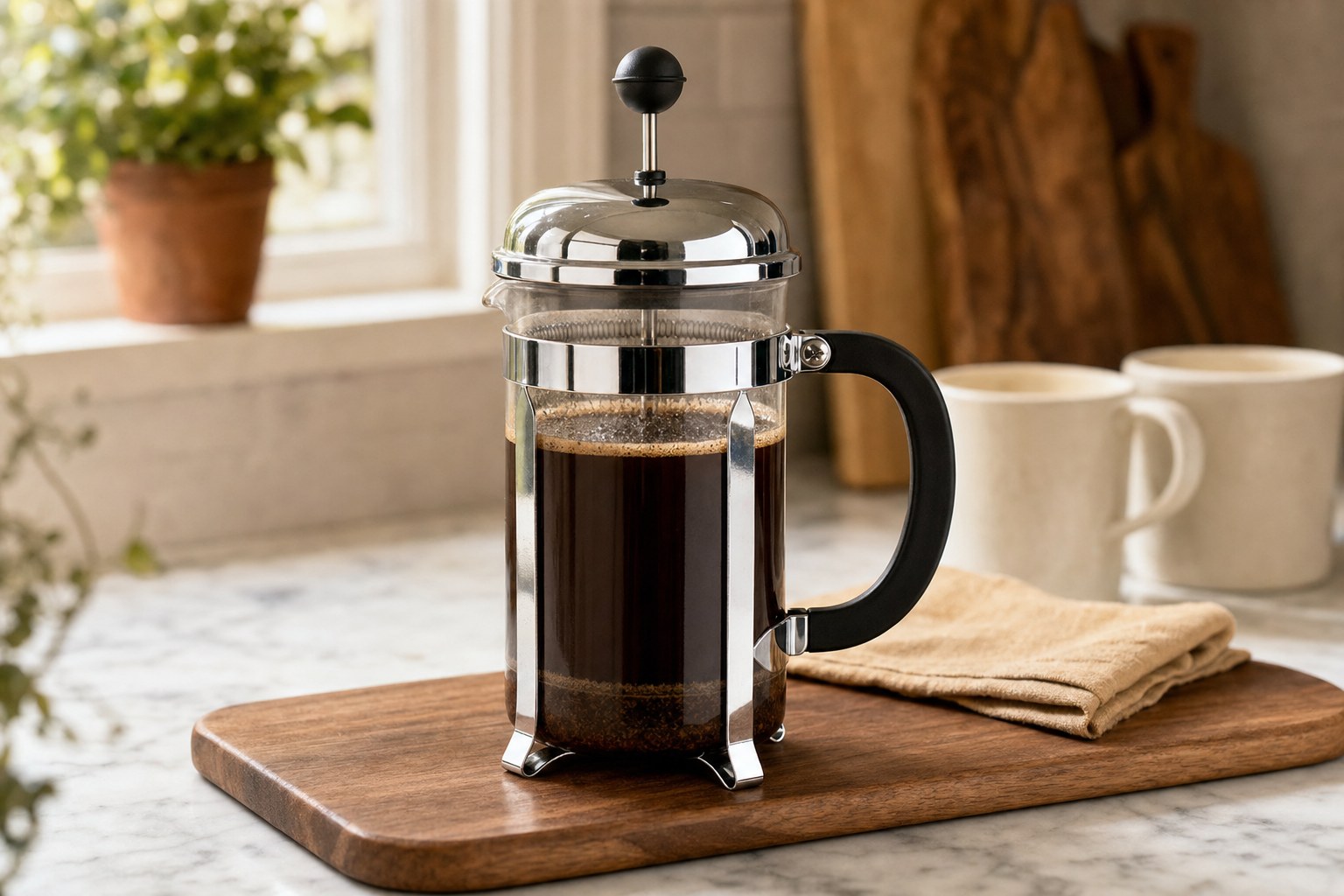
Most French press instructions stop at “add coffee, add water, wait, press.” That gets you a cup, but rarely a good one. Below is the recipe that works on the first try, plus the no-plunge method James Hoffmann popularized for a cleaner cup from the same press.
For a standard 8-cup (34 oz) French press, use 55g of coarsely ground coffee to 825g of water at 200°F (93°C), steep 4 minutes, then plunge slowly. Grind to a sea-salt texture (Baratza Encore setting ~28). If you don’t have a temperature-control kettle, boil the water and rest it 30 seconds off the heat. Pre-warm the carafe with a splash of hot water before adding grounds. Pour ~110g of water for a 30-second bloom, stir gently, then top up to 825g and cap with the plunger pulled all the way up. At 4:00, break the crust with a spoon, plunge slowly over 15-20 seconds, and decant immediately into mugs or a thermal carafe. Leave the last half-inch behind. For an even cleaner cup with almost no sludge, use James Hoffmann’s no-plunge variant covered below.
Some links in this article are affiliate links. If you buy through them, we may earn a commission at no extra cost to you. We only recommend gear we’ve used or studied carefully.
What you need
The default press is the Bodum Chambord (34 oz, around $40). Borosilicate glass beaker, polished stainless frame, replacement beakers cheap if you ever crack one.
The single biggest cup-quality upgrade is a burr grinder. The Baratza Encore (around $170) is the canonical pick. Blade grinders produce fines that slip through the metal mesh and turn the cup silty; the Encore’s 40-step conical burr eliminates that problem at setting ~28.
For temperature you can trust, the Fellow Stagg EKG electric gooseneck kettle (around $170) hits 200°F to the degree instead of asking you to guess the off-boil window.
Two other presses worth knowing: the Espro P7 (~$120) uses a patented double micro-filter reportedly 9-12× finer than standard mesh, which is the move if sludge is your dealbreaker. The Frieling stainless press ($70-$150) is double-walled insulated and keeps coffee hot for hours, which suits groups or long sessions.
A digital scale and a long spoon are non-negotiable. Volume measurements lie.
Step 1: Heat water to 200°F
Target is 200°F (93°C). A variable-temperature kettle like the Fellow Stagg EKG holds the number for you. Without one, bring water to a full boil and rest it 30 seconds off the heat.
Barista Hustle notes that water just off the boil is the right range for French press. Full boiling water is fine for dark roasts but can drive harshness in lighter ones. The slurry drops a few degrees within seconds once the grounds hit, so a small overshoot won’t ruin the cup.
Step 2: Pre-warm the carafe
Pour a splash of hot water into the empty press, swirl 10 seconds, dump it out. Two reasons. Thermal shock is the most common way Bodum Chambords crack: cold glass plus boiling water makes a hairline fracture you won’t notice until coffee leaks out the bottom of the next brew. And a warm carafe holds brew temperature steadier through the 4-minute steep. Stainless presses like the Frieling and Espro P7 don’t crack, but they still benefit from the heat retention.
Step 3: Weigh and grind
For a standard 8-cup (34 oz) press, weigh 55g of coffee against 825g of water. That’s a 1:15 ratio, slightly stronger than the SCA Golden Cup baseline of 1:18 because the French press’s metal filter doesn’t retain oils the way paper does.
Grind coarse, texture of sea salt or breadcrumbs. On a Baratza Encore that maps to setting ~28 per Honest Coffee Guide’s measured chart, with a usable range of 25-30. The Encore’s grind window is roughly 250-1200 microns; French press lives near the top end of that range.
Scott Rao has been clear on why this matters: blade grinders produce a wide distribution of fines that slip the mesh, cause sludge, and over-extract while the rest of the bed under-extracts. A burr grinder fixes it. For other press sizes, see the ratio chart below.
Step 4: Add grounds, tare, and bloom
Add the 55g of grounds to the warm carafe. Place the press on the scale and tare to zero so the readout shows water weight.
Start a timer. Pour roughly 2× the coffee weight in water (about 110g) in a quick circular motion to saturate every ground. Stir gently with a spoon or chopstick to break dry pockets. Wait 30 seconds.
The bloom releases trapped CO2. On coffee roasted within the past two weeks you’ll see a vigorous foam rise; on older beans it’s quieter. The 30-second pause matters either way, because it keeps the main pour from channeling around CO2 pockets.
Step 5: Pour the rest of the water
At 0:30, pour the remaining water in one smooth, fast pour up to 825g on the scale. Steady stream into the center, no need to be precious.
Place the lid on with the plunger pulled all the way up. You’re not pressing yet, just capping in heat. A glass carafe loses 5-8 degrees over a 4-minute steep with the lid off, enough to noticeably under-extract.
Step 6: Steep for 4 minutes
Set the timer to 4:00 and don’t touch it.
Scott Rao has written that immersion is inherently more forgiving than percolation: the slurry sits in coffee-saturated water rather than fresh solvent, so extraction slows as the brew progresses. That’s why French press tolerates a wider grind range than a V60, and why Rao’s own published recipe (95°C water, medium grind, 5:20 brew time) can be pushed slightly further than the standard 4 minutes once you have the baseline down.
Step 7: Break the crust, plunge, and decant
At 4:00, lift the lid. A crust of grounds will be floating on the surface. Use a spoon to break it, then stir twice. Most of the bed sinks, and that’s the move that limits sludge for the classic method.
Replace the lid. Plunge slowly, 15-20 seconds top to bottom. If the plunger resists, ease it back up. A stuck plunger almost always means the grind is too fine, and forcing it pushes fines through the mesh into the cup.
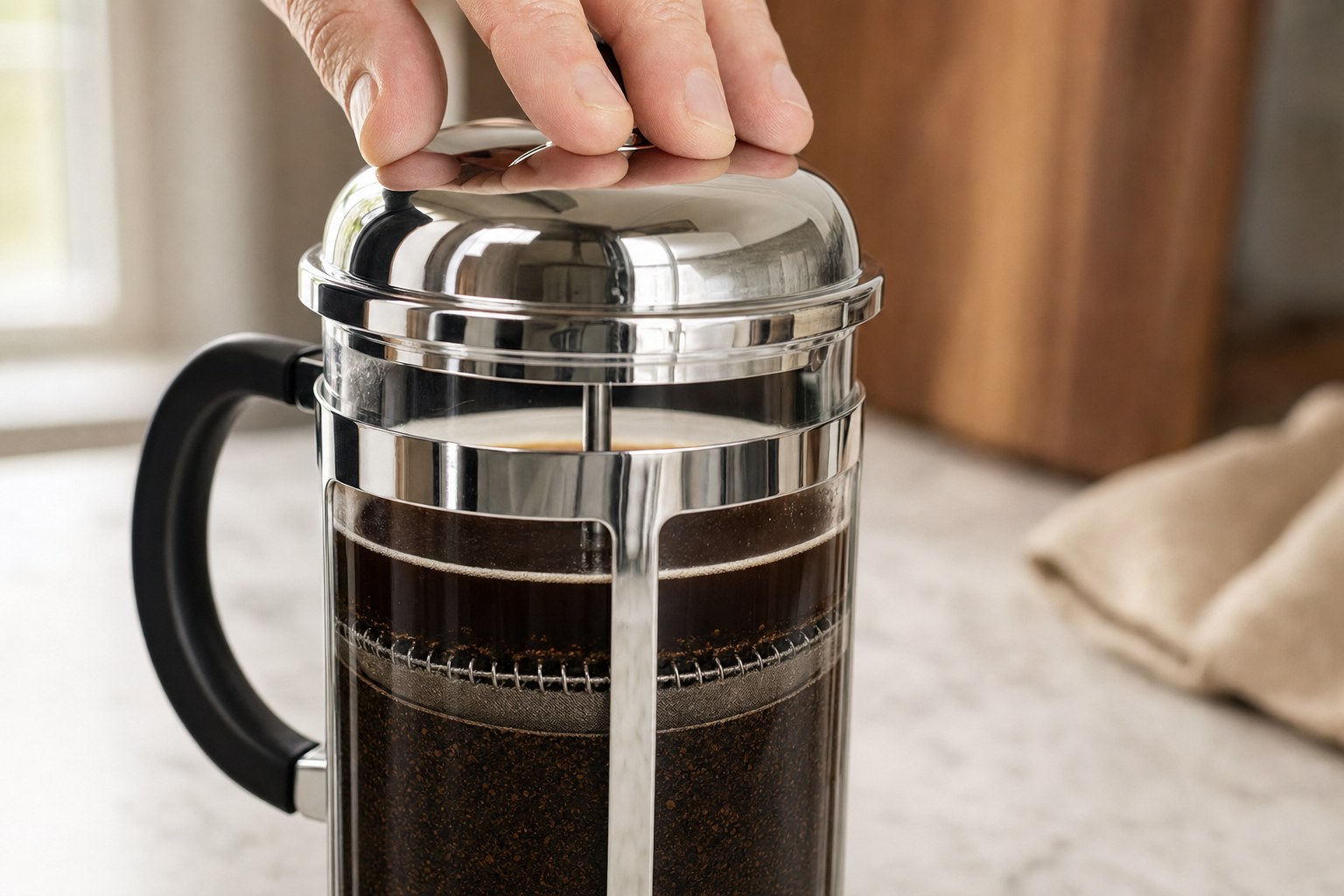
A slow 15-20 second plunge keeps fines from being shoved through the mesh.
Decant immediately into mugs or a thermal carafe. Coffee left on the bed keeps extracting and turns bitter within 2-3 minutes. Leave the last half-inch in the press; that’s where the sludge sits.
Two methods compared: classic vs Hoffmann
Same press, two recipes, two different cups. The classic 4-minute method delivers the heavy, oily body French press is famous for. Hoffmann’s no-plunge method delivers a cleaner finish that drinks closer to a pour-over. Neither is right; they’re tools for different mornings.
| Feature | Classic 4-Minute | Hoffmann No-Plunge |
|---|---|---|
| Total time | ~6 min | ~12 min |
| Coffee:water ratio | 1:15 | 1:16.7 |
| Grind (Baratza Encore) | Coarse, ~28 | Medium-coarse, ~22-25 |
| Water temp | 200°F / 93°C off-boil | Boiling, no rest |
| Steep technique | Bloom, then full pour, lid on | Single pour, crust break + skim at 5:00 |
| Plunge | Slow plunge to bottom (15-20s) | Drop to surface only, strainer not press |
| Mouthfeel | Heavy, full body, oils | Cleaner, pour-over-adjacent |
| Sludge | Some, always | Near zero |
| Best for | Weekday default, dark/medium roasts | Weekend, light/medium roasts, sludge-averse |
The classic method is the weekday default: six minutes start to finish, forgiving, works with dark and medium roasts that already have body to give up.
The Hoffmann method is a weekend brew. Twice as long, two spoons required, and the heavy oily body that dark-roast drinkers love gets softened. In exchange you get almost zero gritty sludge and room for light and medium roasts to show origin character.
The James Hoffmann no-plunge method
Hoffmann reframes the press as a strainer rather than a filter you push through coffee. His full walkthrough is on YouTube (“The Ultimate French Press Technique”) and Seven Coffee Roasters has the written version.
Use 30g of coffee to 500g of water (1:16.7); scale up for an 8-cup press to roughly 50g coffee to 830g water. Grind slightly finer than the classic recipe, around Encore 22-25. Bring water to a full boil; no off-boil rest.
Add grounds to a pre-warmed carafe, tare on the scale, and pour all the boiling water in one smooth pour. No bloom, no stages. Start a timer and walk away for 5 minutes.
At 5:00, gently break the crust with a long spoon and stir 4-5 times. Most grounds will sink. Then comes the move that defines this method: with two spoons, skim the foam and floating fines off the surface and discard them. Hoffmann’s observation is that most fines float and never sink, which is why a traditional plunge churns them back into the cup.
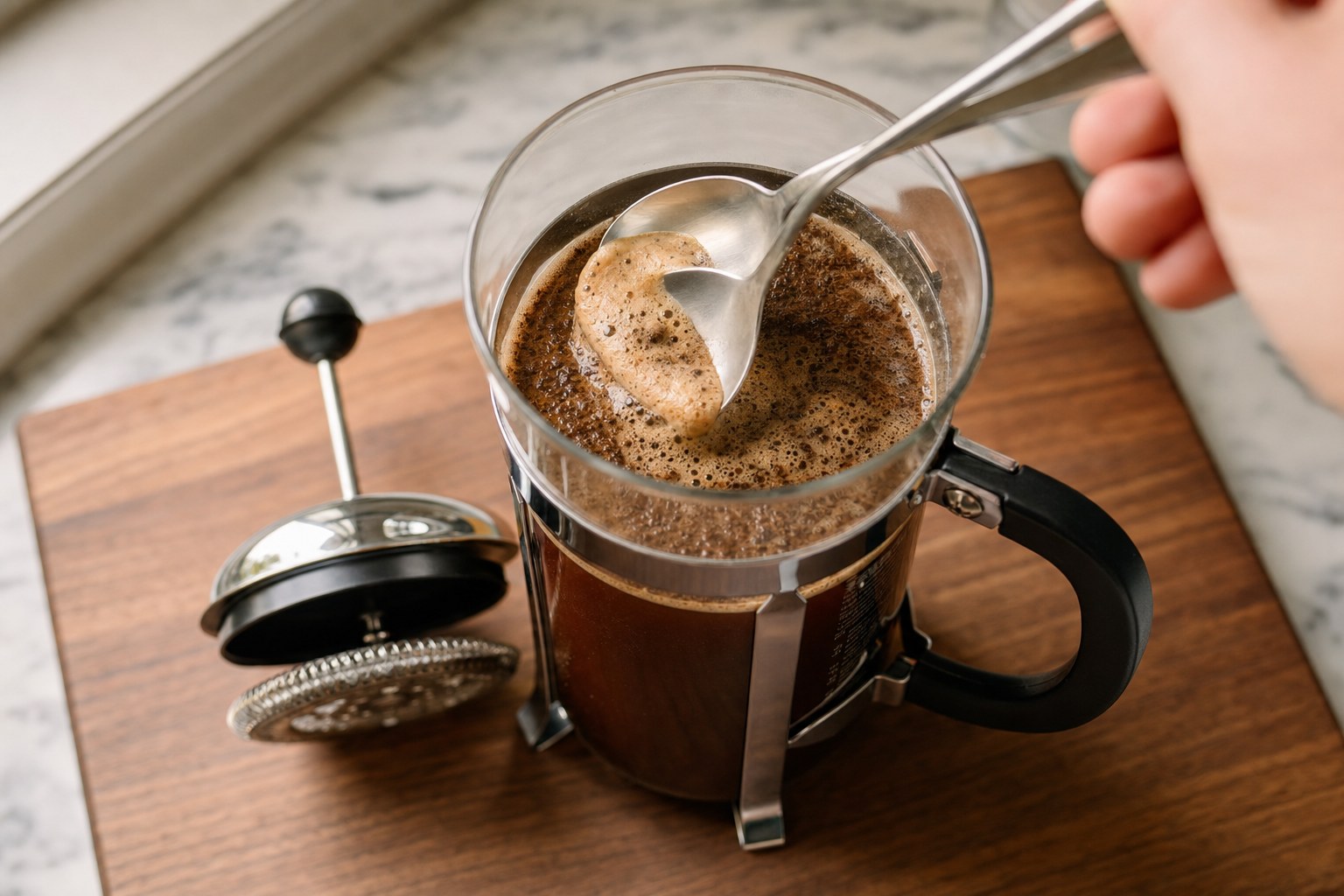
The skim step at 5:00 is the single biggest sludge-reduction move.
Wait until the timer reads 10:00. The remaining grounds settle into a tight bed. Lower the plunger slowly until the screen just touches the surface of the liquid. Do not push it through the coffee bed. The filter is a strainer, not a plunger.
Pour gently, keeping the press level so you don’t stir up the bed. Leave the last inch behind. The result is full French-press body with a noticeably cleaner finish.
Tradeoff: 12 minutes total, two spoons, and the cup can drop below ideal drinking temperature by the time you pour. Pre-warm aggressively and serve immediately.
Ratio chart by press size
The 55g / 825g recipe is sized for the standard 8-cup Chambord. If your press is smaller or larger, scale the math at 1:15.
| Press Size | Coffee (g) | Water (g) | Water (oz) | ~Tbsp Whole Bean |
|---|---|---|---|---|
| 3-cup (12 oz) | 20 | 300 | ~10 | ~3 |
| 8-cup (34 oz) | 55 | 825 | ~28 | ~7-8 |
| 12-cup (51 oz) | 80 | 1200 | ~40 | ~11-12 |
The SCA Golden Cup standard is 55g coffee per liter (roughly 1:18). French press benefits from a slightly stronger 1:15-1:17, per The Way to Coffee’s writeup of the SCA standard, because the metal filter passes oils that paper filters retain.
For other brewers entirely, the brew ratio calculator handles every method with strength and roast-level adjustments built in. If you’d rather measure by volume because you don’t own a scale yet, the tablespoons of coffee per cup reference covers volumetric conversion for whole bean.
Troubleshooting your French press
If your last cup wasn’t right, it’s almost always one of these five problems.
| Problem | Most Likely Cause | Fix |
|---|---|---|
| Bitter / harsh / ashy | Steep > 4 min, water > 205°F, grind too fine, or coffee left in press after plunging | Decant immediately, check kettle temp, coarsen grind one notch |
| Weak / sour / watery | Grind too coarse, water < 190°F, or ratio leaner than 1:18 | Tighten to 1:15, verify 200°F, grind a touch finer (Encore ~25) |
| Sludgy / gritty cup | Blade-grinder fines, pre-ground drip coffee, aggressive plunge, or pouring the dregs | Switch to a burr grinder (Encore), plunge slowly, leave the last half-inch |
| Lukewarm by cup two | Glass carafe losing heat (~15 min to drinking temp) | Pre-warm aggressively, decant into a thermal carafe, or upgrade to Frieling / Espro P7 |
| Stuck plunger | Grind too fine, dose too high for the carafe, or clogged filter screen | Ease back up, stir, re-grind coarser, never force it |
If you want a stronger cup
French press is a brewer for body and richness, not concentration. If you bought one hoping for espresso-strength coffee and the result felt closer to very good drip, that’s not the press underperforming. That’s the lane it’s in.
The Moka pot is the closer match for an espresso-style profile at home: 1-2 bars of stovetop pressure, fine grind, concentrated yield. Our Moka pot vs French press comparison lays out which brewer fits which morning.
Frequently asked questions
Why is my French press coffee bitter?
Almost always one of four causes: grind too fine, water too hot (above 205°F), steep over 4 minutes, or coffee left sitting in the press after plunging. Fix the steep time and decant immediately first; that solves most cases. If it's still bitter, coarsen the grind one notch on your burr grinder. Pre-ground drip coffee is almost guaranteed to taste bitter in a press because it's milled too fine for immersion brewing.
Why does my French press have so much sludge?
Three reasons in order of likelihood. A blade grinder or pre-ground drip coffee creates fines that slip through the metal mesh. Plunging too fast shoves more fines through. And pouring the last half-inch of the carafe drags up sediment that settled out. Switch to a burr grinder like the Baratza Encore, plunge slowly over 15-20 seconds, and leave the dregs behind. If you want near-zero sludge, use Hoffmann's no-plunge method or upgrade to an Espro P7 with its 9-12× finer double mesh.
Why is my French press plunger so hard to push?
Almost always grind too fine. Drip-grind coffee clogs the mesh and the column of water above it has nowhere to go. Don't force it; you'll either push fines through the mesh into your cup or pop the seal and spray hot coffee. Ease the plunger back up, stir the grounds, and try again slowly. If it still resists, decant what you can through the spout and re-grind coarser next time at Encore setting 28 or higher.
Can I use regular pre-ground coffee in a French press?
You can, but most pre-ground coffee on grocery shelves is sized for drip machines, which is too fine for a French press. Expect a bitter, silty cup. Look for a bag explicitly labeled "coarse" or "French press grind," or buy whole beans and grind them yourself. A burr grinder is the single biggest cup-quality upgrade you can make to any press brew, and the Baratza Encore is the canonical entry point at around $170.
How long should I steep French press coffee?
Four minutes from pour to plunge is the classic standard and the recipe you should start with. Scott Rao's published variant runs slightly finer grind and 5:20 total brew time for a small extraction bump. James Hoffmann's cleaner-cup method extends total contact to roughly 10 minutes with a skim step at 5:00 and a settle period before pouring. Past 10 minutes the cup turns bitter and over-extracted regardless of method.
Can I use boiling water in a French press?
Yes. Hoffmann uses fully boiling water directly. Most guides suggest resting it 30 seconds off the heat to land around 200°F (93°C), which Barista Hustle notes is more forgiving for lighter roasts. Either approach works. The one mandatory step with boiling water is pre-warming a glass carafe first by swirling hot water inside and dumping. Cold glass plus boiling water is how Bodum Chambords crack.
How do you clean a French press?
After each brew, disassemble the plunger (filter screen, cross plate, and gasket all come apart), dump or compost the grounds, and rinse everything in hot water. Once a week, soak the disassembled parts in a 50/50 hot water and white vinegar solution for 30 minutes to strip rancid coffee oils trapped in the mesh and gasket. Those oils are what cause the stale, musty taste that creeps into a press that "looks clean."
One press, two recipes. The classic 4-minute method handles the weekday cup; Hoffmann’s no-plunge variant handles the weekend pour. For other brewers, our brewing methods hub compares the French press against pour-over, AeroPress, moka pot, and the rest.