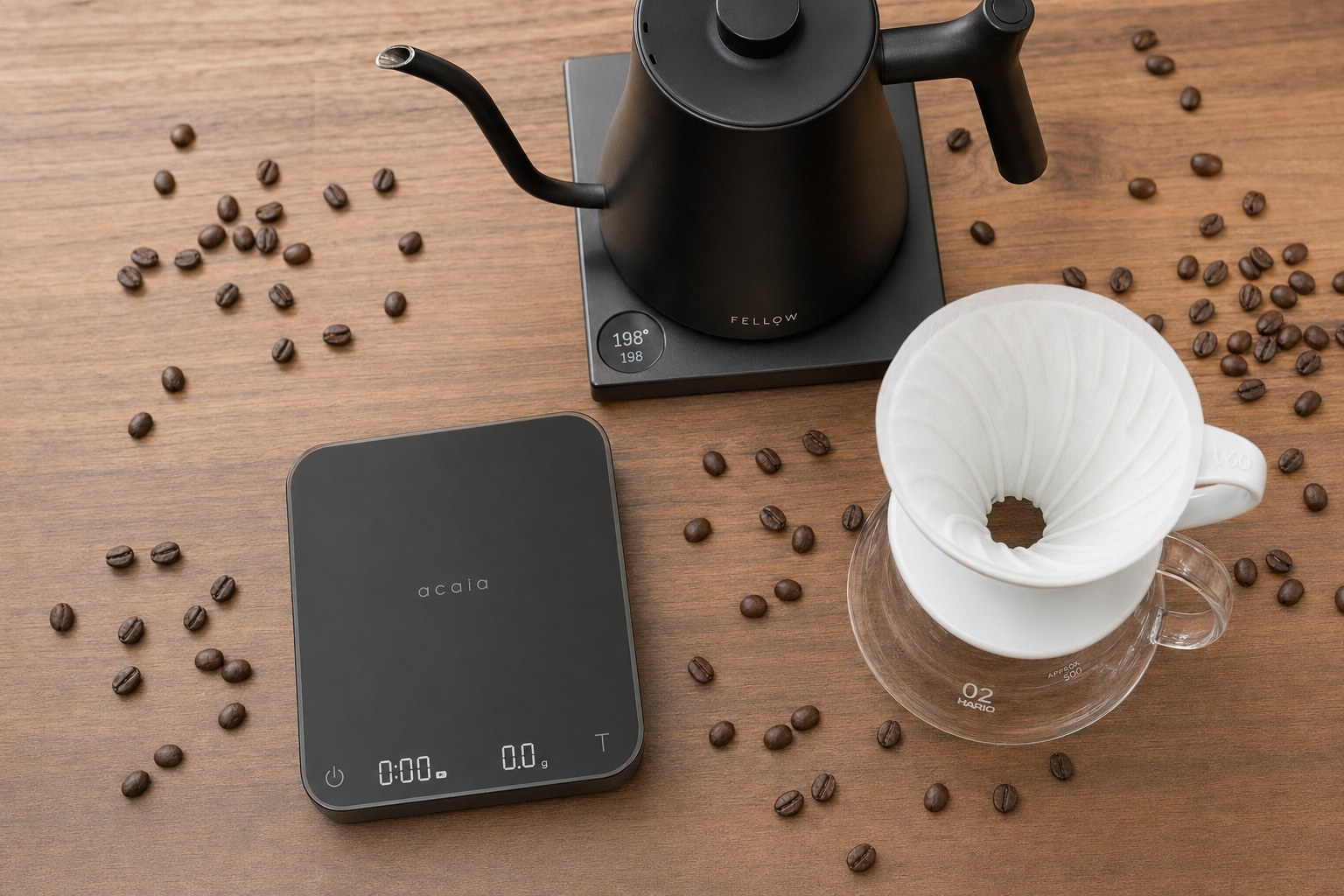
Every brew method has a different sweet spot. The Hario V60 wants 1:16. A Bodum Chambord French press wants 1:15. A Bialetti Moka Express enforces something closer to 1:8 by design, and an espresso shot lives at 1:2. Plug your numbers into the calculator below; the rest of the page covers the gear, the math, and what to change when the cup tastes off.
A coffee brew ratio is the weight of dry grounds compared to the weight of water, written as 1:N. For most filter methods (pour over, drip, French press), start at 1:16 by weight: 1 gram of coffee for every 16 grams of water. That means 18 to 19 grams of coffee for a 300 ml cup, or 30 grams for a 480 ml French press. Espresso runs much tighter at 1:2 (18 grams in, 36 grams out, pulled in 25 to 30 seconds). Cold brew concentrate runs much wider at 1:8, then gets diluted 1:1 before drinking. The SCA Golden Cup standard centers on 1:18 (55 g per liter), but specialty drinkers usually pull tighter for body. Always measure by grams, not tablespoons. A tablespoon of ground coffee can vary 20 to 40% in mass depending on roast and grind, which is why volume measuring produces wildly inconsistent cups.
Ratios sourced from SCA, James Hoffmann, Counter Culture Coffee, and Stumptown brew guides
Ratio Reference: All 8 Methods at a Glance
Use the “Start Here” column as your default the first time you brew with a new method, then adjust by 1 step in either direction based on taste. Every ratio in the table is coffee-to-water by weight, in grams.
| Method | Ratio Range | Start Here | Grind | Brew Time | Water Temp |
|---|---|---|---|---|---|
| Pour Over (V60) | 1:15–1:17 | 1:16 | Medium-fine | 2:30–3:30 min | 200–205°F |
| Pour Over (Chemex) | 1:16–1:17 | 1:17 | Medium | 4:00–5:00 min | 200–205°F |
| Pour Over (Kalita Wave) | 1:15–1:16 | 1:16 | Medium-fine | 3:00–4:00 min | 200–205°F |
| French Press | 1:14–1:17 | 1:15 | Coarse | 4–12 min* | 200°F |
| AeroPress | 1:12–1:17 | 1:13 | Medium-fine | 1:30–3:00 min | 195–205°F |
| Moka Pot | 1:7–1:10 | 1:8 | Medium-fine | 5–7 min | Stovetop |
| Cold Brew | 1:4–1:8 | 1:8 | Coarse | 12–14 hrs | Cold (40°F) |
| Espresso | 1:1.5–1:3 | 1:2 | Fine | 25–30 sec | 197–205°F |
| Drip/Auto-Drip | 1:15–1:18 | 1:17 | Medium | 4–6 min | 195–205°F |
| Siphon | 1:14–1:16 | 1:15 | Medium | 3–4 min | ~210°F |
*French press 4–12 min reflects the Hoffmann no-plunge method: 4-minute brew, then a 5–8 minute settle before pouring. A standard plunge-and-pour French press finishes at 4 minutes flat.
How to Read a Brew Ratio (and Why You Should Weigh)
A 1:16 ratio means 1 gram of coffee for every 16 grams of water. One gram of water equals 1 ml at room temperature, so weight and volume are interchangeable on the water side. The grounds side is where scoops fall apart.
The math is one division. To find your dose, divide your target water by your ratio.
300 g water ÷ 16 = 18.75 g → round to 19 g coffee
That’s it. A 500 g brew at 1:15? 500 ÷ 15 = 33 g of coffee. A 250 ml mug at 1:17? 250 ÷ 17 = 14.7 g, round to 15.
Ground coffee density swings hard with roast and grind. A tablespoon of coarse-ground light roast and a tablespoon of fine-ground dark roast can differ by 20 to 40% in actual mass, which is the difference between a 1:13 cup and a 1:18 cup using the exact same scoop. The tablespoons-of-coffee-per-cup conversion page covers the rough volume-to-weight math, but the answer is always the same: buy a scale.
A budget OXO Brew Precision Scale ($49.99) reads to 1 gram and includes a built-in pour-over timer. The Acaia Pearl ($150) reads to 0.1 g and streams flow rate to a phone app for dialing in. Either is enough. The SCA Golden Cup target is 18 to 22% extraction yield with a brewed TDS of 1.15 to 1.35%, and you cannot hit those numbers consistently if your dose is drifting by 4 grams every brew.
Pour Over: V60, Chemex, and Kalita Wave
The three classic drippers brew the same beans differently because they shed water at different speeds. The Hario V60 ($30.50) has a single large hole and 60-degree spiral ridges, so flow is fast and pourer-controlled. The Chemex 8-Cup Classic ($51.50) uses a thicker proprietary filter that drains slowly. The Kalita Wave 185 ($42) is flat-bottomed with three small holes, which slows extraction even more and forgives a slightly off pour. Same coffee, three different ratio sweet spots.
For the V60, James Hoffmann’s published recipe is 60 g per liter, which is 1:16.7, and that’s the number to memorize. Hario’s own recipes float between 1:16 and 1:17.25. Start at 1:16 (20 g coffee, 320 g water) and let the cup tell you which way to move. The pour-over coffee ratio deep-dive walks through the bloom, pulse pours, and timing in detail.
The Chemex pulls a touch wider, mostly because the slower drain means more contact time at the same dose. Counter Culture publishes 45 g coffee to 750 g water (1:17). Stumptown’s 8-cup recipe is 42 g to 700 g (1:16.7). Either gets you a clean, bright cup with the body the Chemex filter is known for stripping away. Bloom with about 150 g of water for 30 to 45 seconds before continuing.
The Kalita Wave 185 sits between the two at 1:15 to 1:16. Most specialty cafes start at 25 g coffee to 400 g water and adjust grind, not ratio, when dialing a new bean.
Across all three, bloom rule of thumb: pour 2 to 3× the coffee weight in water first, wait 30 to 45 seconds for CO2 to off-gas, then continue. Roast level matters too. Dark roasts extract fast and read better at 1:15. Light roasts are denser and benefit from 1:17 to keep brightness without thinness. Lance Hedrick’s pour-over rule is 1:14 to 1:15 for darks and 1:16 to 1:17 for lights, which is a clean way to remember it.
Kettle matters too. The Fellow Stagg EKG Pro ($199.95) holds a set temperature (200 to 205°F for filter), runs a built-in stopwatch, and pours a thin controlled stream from its gooseneck spout. None of that changes your ratio, but it makes hitting the same ratio twice in a row possible.
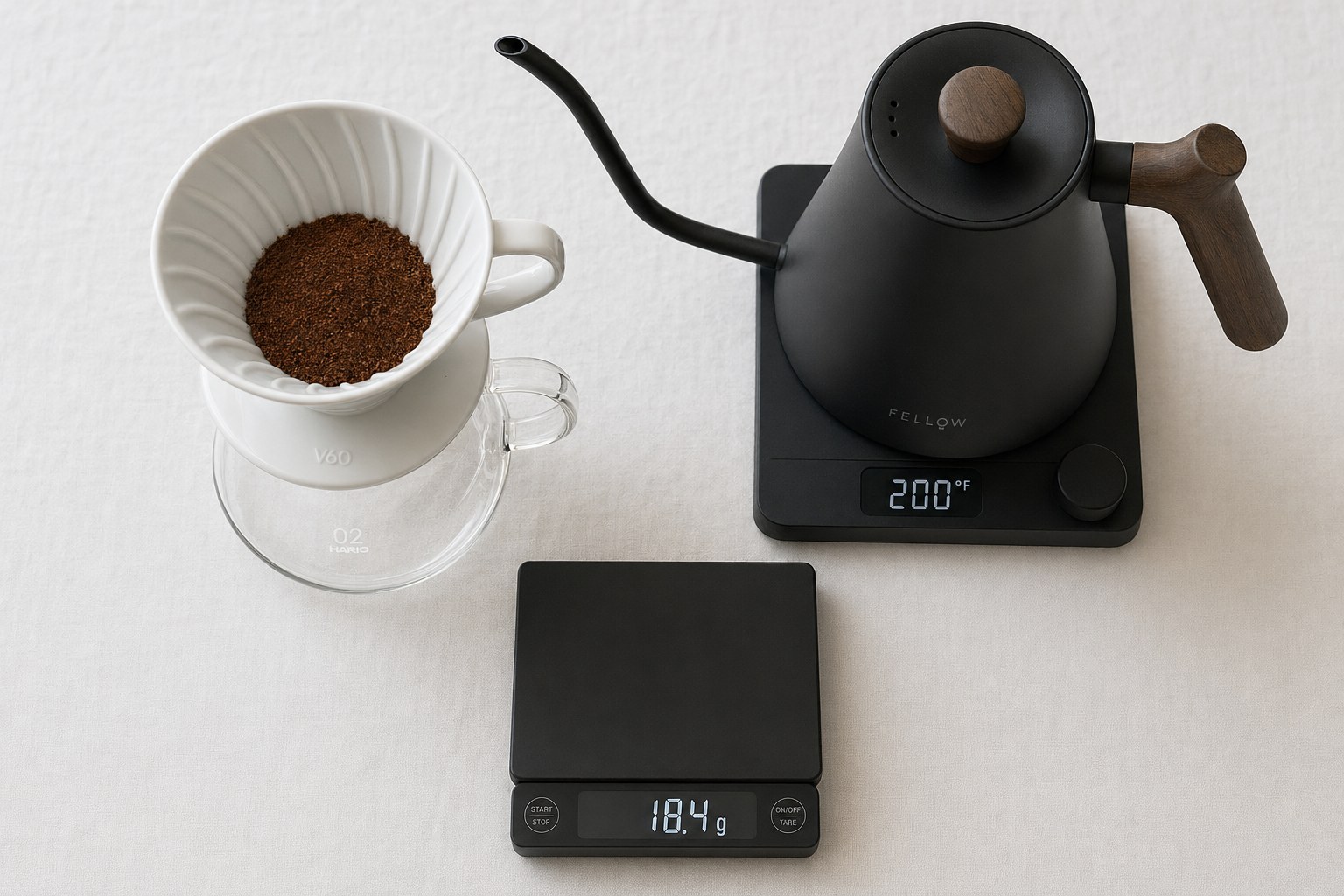
The V60 rewards precision: a digital scale and a gooseneck kettle are the two tools that make the most difference.
French Press: The Bodum Chambord at 1:15
The French press is full immersion: water sits in contact with grounds for the entire brew time, so extraction runs higher than in a draining brew and the ratio has to lean tighter to keep things from turning bitter. Hoffmann’s number is 1:15, or 30 g coffee to 450 g water for a 4-cup brew. A full Bodum Chambord 34 oz ($39.99) is 60 to 64 g coffee to 1,000 g water at the same ratio.
Coarse grind is non-negotiable. The mesh filter on a French press is wide enough that fine grounds slip through and over-extract during the four-minute steep, which is the source of most “French press tastes muddy” complaints. Aim for a setting around 30 to 32 on a Baratza Encore, or whatever your grinder labels “French press / coarse.” The grounds should look like sea salt or breadcrumbs, not sand.
The standard recipe is brain-dead simple: pour, wait 4 minutes, plunge slowly, serve. Hoffmann’s no-plunge variant takes longer but eliminates sediment. After the 4-minute steep, break the surface crust with a spoon, skim the foam, and let the press sit lid-on (don’t push the plunger) for another 5 to 8 minutes. The fines settle to the bottom. Pour slowly off the top and you get a cup with the body of a French press and the clarity of a pour over. Total brew time runs 9 to 12 minutes.
For a side-by-side on this brewer against the most-confused alternative, the moka pot vs French press comparison covers when to choose each.
AeroPress and Moka Pot: Two Different Concentration Games
The AeroPress and the moka pot both produce something strong, but their ratios live in opposite places, and confusing the two produces some of the worst cups in home coffee.
The AeroPress Original ($39.95) ships with a 1:6 recipe by design. That’s not a normal cup, that’s a concentrate meant to be diluted with hot water or milk after brewing. Specialty drinkers who want a clean, full-strength cup straight from the press use 1:12 to 1:13: Counter Culture’s published recipe is 18 g coffee to 210 g water (1:11.7) for an inverted brew. The chamber holds about 250 g of water max, so anything wider than 1:13 is hard to fit. The AeroPress Go ($49.95) is the same brewer in a smaller travel chamber, which caps you around 220 g water and forces a tighter dose. Same ratio rules, smaller batch.
Moka pots are the opposite problem. The Bialetti Moka Express has the ratio baked into the hardware. You fill the bottom chamber to the safety valve, fill the basket level with medium-fine grounds, and screw it shut. That’s roughly 1:7 to 1:10 depending on the model. The 3-cup ($35–40) yields about 150 ml of brew from around 14 g coffee and 100 g water. The 6-cup runs about 28 g coffee to 280–345 g water. Don’t tamp the grounds, don’t overfill past the valve, and don’t expect a 1:16 ratio. The pot decides.
Grind for the moka pot is medium-fine, finer than drip, coarser than espresso. Tamping or going espresso-fine clogs the basket, spikes the pressure, and produces something burnt and angry rather than a clean stovetop concentrate.
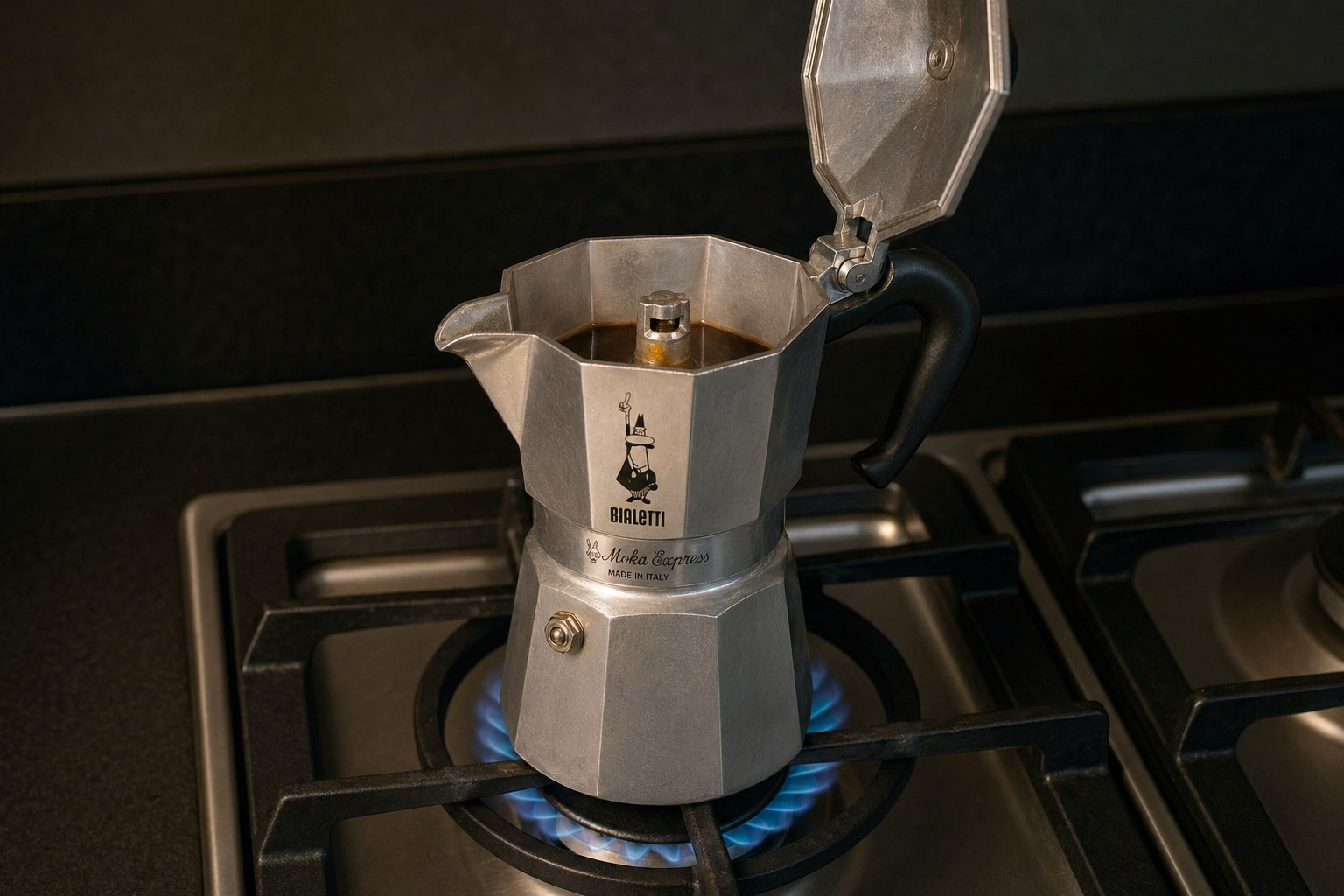
The Moka Express’s octagonal chamber is designed to produce a fixed ratio — fill the basket level and don’t tamp.
Cold Brew and Espresso: The Outliers
Cold brew runs wider, espresso runs tighter, and both use a notation that trips up anyone coming from pour over.
Cold brew works at room temperature or below, which slows extraction to a crawl. To get a drinkable cup out of cold water you need more time, more coffee, or both, and good cold brew uses both. Counter Culture’s published recipe is 1:8 (125 g coffee per 1,000 g cold filtered water) steeped 14 hours in the fridge. That’s a concentrate, not a finished drink.
To serve, dilute 1:1 with cold water or milk over ice. The math: 125 g coffee plus 1,000 g water yields about 1,000 ml of concentrate, then 1:1 dilution gives 2,000 ml of ready-to-drink cold brew at roughly a 1:16 effective ratio. You can also brew at 1:8 and drink it neat, but the brew-strong-then-dilute approach gives you one batch that covers espresso tonics, milk drinks, and iced lattes from the same fridge jar.
Grind coarse. Filter through paper for clarity, cheesecloth for body. Never apply a hot-brew 1:16 ratio to cold water. You will get something thin, sour, and disappointing.
Espresso flips the notation: dose-in to yield-out, both in grams, not coffee to water. The standard 1:2 ratio means 18 g of dry coffee in the basket, 36 g of liquid espresso in the cup, in 25 to 30 seconds. Ristretto pulls tighter at 1:1 to 1:1.5 (18 g in, 18 to 27 g out). Lungo pulls wider at 1:2.5 to 1:3 (18 g in, 45 to 54 g out).
Scott Rao’s advice: lock the ratio first and adjust only the grind to dial in flavor. Change two variables at once and you cannot tell which one fixed the shot. Sour and fast? Grind finer. Bitter and slow? Grind coarser. Always weigh the yield on a scale, because crema sits on top of the cup and lies about how much liquid is actually there.
How Grind Size and Ratio Interact
Ratio and grind are independent variables that change different things, and most “the ratio is wrong” complaints are actually grind problems in disguise.
Ratio controls strength. More coffee relative to water = stronger cup. Less coffee relative to water = weaker cup. That’s it.
Grind controls extraction speed. Finer particles have more surface area, so flavor (and bitterness) come out faster. Coarser particles extract slower. Same ratio, two different grinds, two different cups: the fine version will taste more extracted (more sweetness if you nailed it, more bitterness if you didn’t) and the coarse version will taste less extracted (more brightness if you nailed it, more sourness if you didn’t).
The decision tree when something tastes off:
- Bitter: coarsen the grind first. Re-brew. If still bitter, widen the ratio by 1 step (1:14 → 1:15).
- Sour: fine the grind first. Re-brew. If still sour, tighten the ratio by 1 step (1:17 → 1:16).
Change one variable per brew. If you adjust both grind and ratio at the same time, you’ve learned nothing about which one fixed the cup.
Roast level interacts with both. Light roasts are dense and slower to extract, so finer grind or tighter ratio helps. Dark roasts are porous and faster to extract, so coarser grind or wider ratio helps. The SCA target of 18 to 22% extraction yield is achievable across roast levels, but you have to meet the bean where it lives.
Quick Fixes: When Your Cup Tastes Off
Three common symptoms map to three ratio-or-grind moves. Try the cheap fix first.
Bitter or harsh. Probably over-extracted. Likely cause: grind too fine, ratio too tight, or both. Try coarsening the grind one step before changing anything else. If still bitter, widen the ratio (1:14 → 1:15 → 1:16). Water that’s too hot (above 205°F for most filter methods) also pushes bitterness, so let the kettle sit 30 seconds off the boil if you don’t have temperature control.
Sour or tart. Probably under-extracted. Likely cause: grind too coarse, ratio too loose, brew time too short, or water too cool (below 195°F). Try grinding finer first. If still sour, tighten the ratio (1:17 → 1:16 → 1:15). Light roasts naturally read brighter and can taste sour at ratios that work fine on dark roasts; for very light beans, finer grind and 205°F water do more than ratio changes.
Weak, watery, or flat. Ratio is too loose for the method. A 1:20 cup almost always reads thin. Tighten to 1:16 for filter or 1:15 for full immersion. If the cup is still flat at 1:15, the beans are likely the problem. Coffee older than three weeks past roast date loses noticeable flavor, and supermarket beans with no roast date printed are usually past that point.
Not every off cup is a ratio problem. Stale beans, water below 195°F, an unrinsed paper filter, or a dirty grinder will all wreck a brew at any ratio. Fix the easy variables before chasing the hard ones.
Go Deeper
- Brewing methods overview: the cluster home page, with hub links to every method covered on RoastRanker.
- Tablespoons of coffee per cup: for readers without a scale, the volume-to-weight conversions and where they break down.
- Pour over coffee ratio: V60, Chemex, and Kalita Wave dialed-in recipes with bloom timing and pulse pour technique.
- Moka pot vs French press: when to pick each brewer, with side-by-side ratio and grind specs.
Frequently Asked Questions
What is the best coffee to water ratio?
For most home brew methods (pour over, French press, drip), 1:15 to 1:16 by weight is the right starting point: 15 to 16 grams of water per gram of coffee. The SCA Golden Cup standard runs slightly wider at about 1:18 (55 g per liter), but specialty drinkers usually pull tighter for more body. The actual best ratio depends on your method, roast level, and taste, which is why every method on this page lists a range plus a recommended starting point.
How much coffee per cup?
For a standard 240 ml (8 oz) cup at 1:16, use 15 grams of ground coffee. For a 250 ml mug at 1:16, that's 15.6 grams (round to 16). For a larger 350 ml pour-over cup, use 20 to 22 grams. Always weigh on a scale. A tablespoon of ground coffee is roughly 5 grams but varies 20 to 40% with grind size and roast level, which is why scoop-based dosing produces inconsistent results.
What is the golden ratio for coffee?
The SCA Golden Cup standard is approximately 1:18 (55 g coffee per liter of water), which targets a brewed TDS of 1.15 to 1.35% and an extraction yield of 18 to 22%. In practice, most specialty coffee brewers use 1:15 to 1:17 for more body. Fellow's Q Grader puts it bluntly: there is no single golden ratio. Variables include brew method, roast profile, bean density, water temperature, and personal preference. Treat 1:16 as the safest universal starting point.
How do I make my coffee stronger?
Use a tighter ratio: instead of 1:16, try 1:15 or 1:14. That means more coffee for the same amount of water. Don't extend brew time to compensate, because that pushes extraction past the sweet spot and produces bitterness rather than strength. If the cup is strong but unpleasant, the issue is grind size or extraction, not ratio: coarsen the grind one step and try the tighter ratio again.
What does a 1:15 ratio mean?
A 1:15 ratio means 1 gram of coffee for every 15 grams of water. Coffee is always the first number, water is always the second. For a 300 ml (300 g) brew at 1:15, divide 300 by 15 to get 20 g of ground coffee. For a 450 g French press brew, 450 divided by 15 equals 30 g of coffee. The notation never reverses, so any time you see 1:N in coffee, the small number is the dose and the large number is the water.
How many grams of coffee per 250ml?
At a 1:16 ratio: 250 divided by 16 equals 15.6 grams (round to 16 g). At a 1:15 ratio: 250 divided by 15 equals 16.7 grams (round to 17 g). At a 1:17 ratio: 250 divided by 17 equals 14.7 grams (round to 15 g). For most pour-over and drip methods, 15 to 17 g of ground coffee per 250 ml is the working range. A precision scale like the OXO Brew ($49.99) makes this trivial to hit accurately.
Does grind size affect ratio?
Grind size and ratio are separate variables that interact. Ratio controls strength (how much coffee relative to water). Grind controls extraction speed (how fast flavor pulls out). A finer grind extracts faster, which can make a 1:17 ratio taste like a 1:15 brew. A coarser grind extracts slower, which can make a 1:15 ratio taste under-extracted. Rule: change one variable per brew so you can tell which one mattered. Fix bitterness with grind first, then ratio.
What ratio should I use for espresso?
The specialty coffee industry standard is 1:2, which works out to 18 g of ground coffee dose, 36 g of liquid espresso in the cup, pulled in 25 to 30 seconds. Ristretto runs tighter at 1:1 to 1:1.5 for an intense, syrupy shot. Lungo runs wider at 1:2.5 to 1:3 for a longer, cleaner shot, which suits lighter roasts. Scott Rao's advice: lock the ratio at 1:2 first, then adjust only the grind to dial in. Always weigh the yield, not measure by volume.