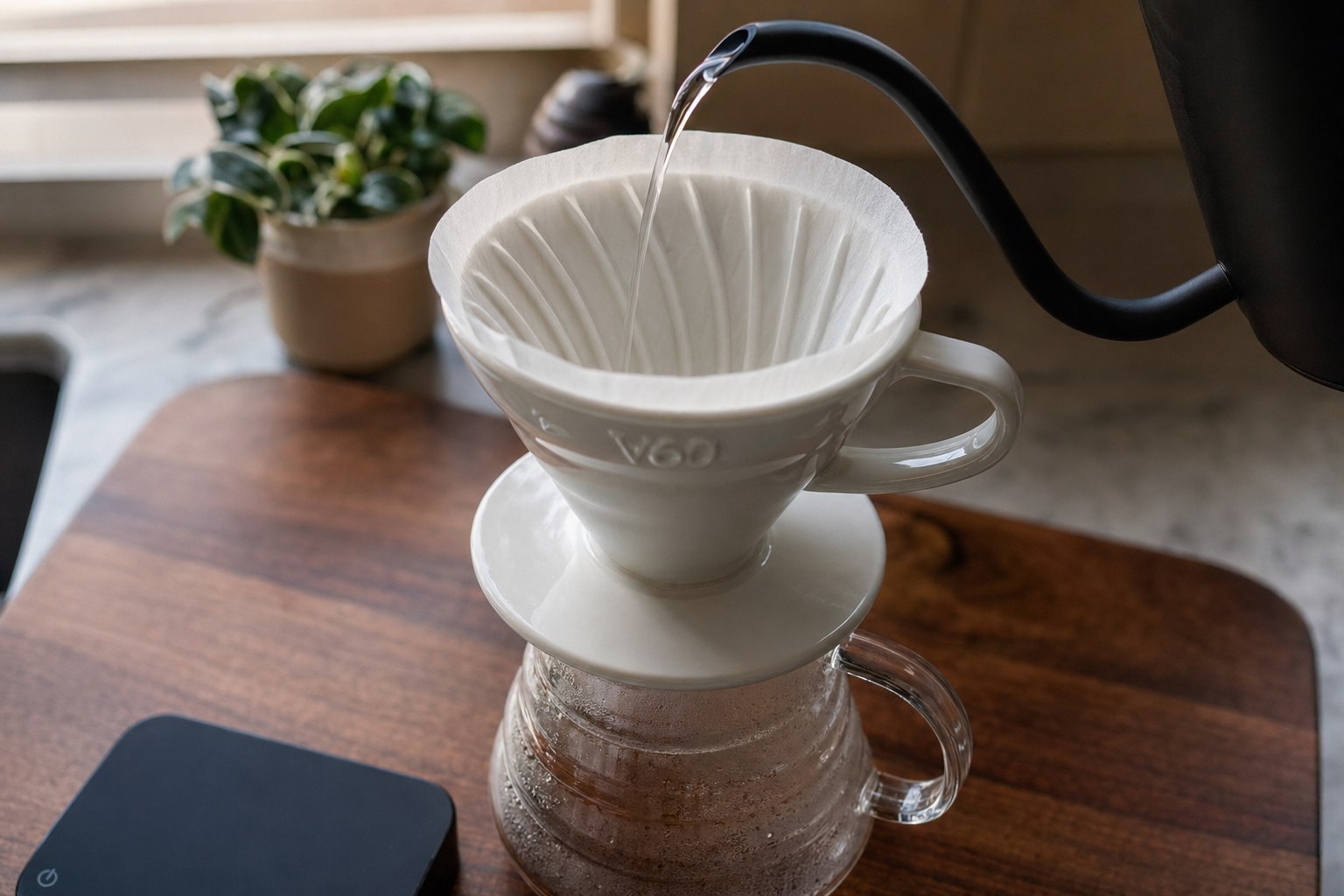
Pour over coffee is the easiest way to taste a single-origin bean for what it actually is. The method is a three-minute routine on a Hario V60: rinse, bloom, pour, drink. The hard part is doing the same thing twice, and a scale plus a thermometer fixes that. The recipe below is the one we run every morning on a V60 02.
To make pour over coffee on a Hario V60 02, use 20 g of medium-fine ground coffee, 320 g of water at 200°F (93°C), and a 1:16 ratio. Rinse the paper filter with hot water and discard. Add the grounds and tap the dripper level. Start a timer, pour 40 g of water in slow concentric circles to bloom for 30 seconds, then continue spiraling from the center to 320 g total by 1:45. Give the dripper one gentle clockwise swirl to flatten the bed. Drawdown finishes between 2:30 and 3:00. The result is a clean, bright cup that highlights origin notes the way an immersion brewer can’t. Adjust grind, not ratio, until you have brewed it five times and know your starting point.
Some links in this article are affiliate links. If you buy through them, we may earn a commission at no extra cost to you. We only recommend gear we’ve used or studied carefully.
What you need to brew V60 pour over
Five pieces of gear, in order of how much they change the cup:
- Hario V60 02 dripper. The 60-degree cone with internal spiral ridges and a single large hole is the geometry the recipe is tuned to. The V60 02 covers 1 to 4 cups (15 to 40 g of coffee) and is the right default size. Plastic ($8 to $12) has the lowest thermal mass and keeps the brew temperature highest. Ceramic ($23 to $30) feels premium and holds heat once preheated, but absorbs heat from the slurry as it brews. Both make the same coffee in trained hands.
- Hario 02 paper filters. Bleached white. Roughly $5 to $8 per 100. Always rinse before brewing.
- Gooseneck kettle. A Fellow Stagg EKG ($165) gives variable temperature in 1°F steps. The Bonavita 1.0L ($50 to $65) does the same job without the precision. The narrow spout is the upgrade that matters.
- 0.1 g scale. An Acaia Pearl S ($160) is the pro-level option with a built-in pour-over mode. Any kitchen scale with a tare button works to start.
- Burr grinder. A Baratza Encore ($170) is the entry point. Pre-ground coffee stales fast and won’t taste right at this resolution.
The ratio: 1:16, every time
Use 1:16 by weight. One gram of coffee for every 16 grams of water. The math is one division: water weight divided by 16 is your coffee dose. James Hoffmann, the 2007 World Barista Champion and Hario Europe ambassador, runs slightly looser at 60 g per liter (1:16.7). The Specialty Coffee Association’s Golden Cup standard is 55 g per liter (about 1:18). All three live inside the working range; 1:16 is the easiest number to remember. Scale your dose to mug size before you start. The full breakdown is in our pour over coffee ratio guide.
| Mug size | Coffee (1:16) | Water | Brew time |
|---|---|---|---|
| 8 oz (240 g) | 15 g | 240 g | 2:30 |
| 12 oz (320 g) | 20 g | 320 g | 2:45 |
| 16 oz (480 g) | 30 g | 480 g | 3:15 |
| 24 oz (720 g) | 45 g | 720 g | move to V60 03 |
Step 1: Rinse the filter and preheat
Boil water. Place a Hario 02 paper filter in the dripper, set the dripper on your mug, and pour about 200 g of hot water through the filter. Let it run all the way through, then pour the rinse water out of the mug. Rinsing flushes the papery taste that the dry filter would otherwise dump into your cup, and the hot water preheats the dripper and the mug at the same time. Skipping this step costs you about 10°F of brew temperature and a noticeable cardboard note. The whole rinse takes 20 seconds.
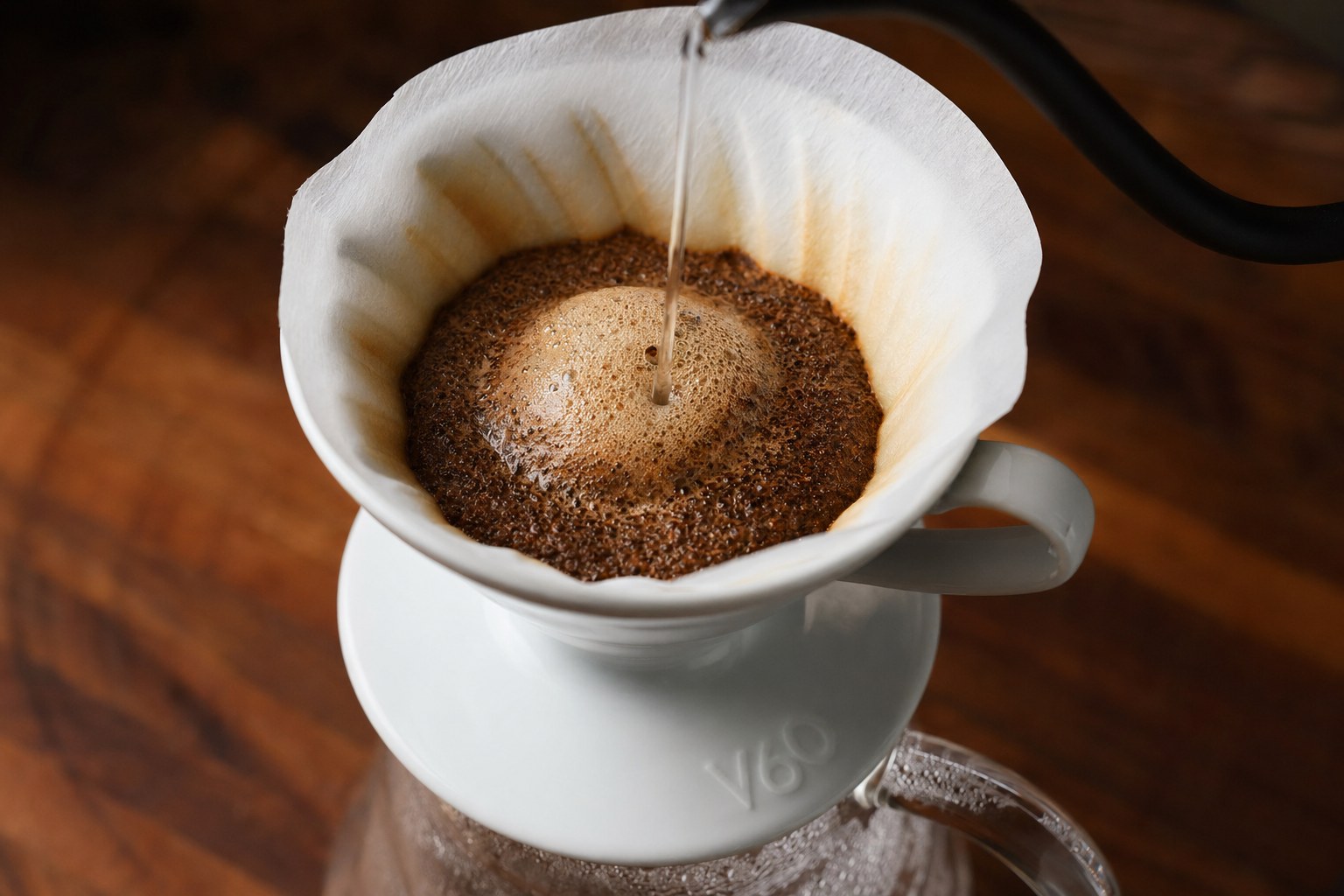
The bloom releases CO2 from freshly roasted beans; without it, water can’t reach the soluble compounds underneath.
Step 2: Weigh and grind 20 g of coffee
Place your dripper on the scale, tare to zero, and add 20 g of coffee ground medium-fine. The grind should feel like table salt or slightly coarser between your fingers. On a Baratza Encore, that is around setting 18 to 22; on a Comandante, click 22 to 26. Pre-ground coffee from a bag is almost always too coarse for a V60 and goes stale within a week of opening. Tap the side of the dripper twice to settle the bed flat, and use a finger or chopstick to dimple the center where you’ll pour. A flat bed is what gives even extraction; a sloped bed channels.
Step 3: Bloom with 40 g of water (0:00 to 0:30)
Tare the scale to zero. Start your timer. Pour 40 g of water in slow concentric circles, starting at the center and spiraling out, wetting every ground without driving water onto the filter wall. Stop pouring at 40 g. The grounds will swell and release CO₂ trapped from roasting; you’ll see a brown dome bubble up. Wait until the timer hits 0:30. The bloom is not optional. CO₂ blocks water from reaching the soluble compounds that make coffee taste like coffee. Skip the bloom and you under-extract no matter how perfect the grind is.
Step 4: Main pour to 320 g (0:30 to 1:45)
At 0:30, restart your pour. Move in slow spirals from the center outward, then back to the center, never touching the paper. Hit 160 g of water by 1:00. Pause for five seconds while the bed drops slightly, then pour again to reach 320 g total by 1:45. The aim is a steady, predictable flow rate and a level bed throughout. If the water level threatens to rise above the top edge of the dripper, slow down. If the bed dries out and cracks before you finish, you paused too long. The pour pattern is more forgiving than the schedule; the schedule is what matters.
Step 5: Swirl, then let it draw down (1:45 to 3:00)
At 1:45, with all the water in, give the V60 one gentle clockwise swirl to flatten the bed and dislodge any grounds stuck high on the filter wall. This is Hoffmann’s swirl trick and it does two things: it evens out extraction across the bed, and it pulls fines off the wall so they keep contributing instead of sitting dry. Don’t stir. Stirring drives fines into the filter and stalls the drawdown. Drawdown should finish between 2:30 and 3:00. Pull the dripper, swirl the mug to mix the layers, and taste. A good cup tastes balanced from sip one to the bottom of the mug.
Troubleshooting: sour, bitter, or weak
Three patterns cover almost every bad pour over. Diagnose by taste, then change one variable at a time.
| What you taste | Likely cause | One fix |
|---|---|---|
| Sour, lemony, thin | Under-extracted (water too cool, grind too coarse, drawdown under 2:00) | Grind one notch finer |
| Bitter, drying, harsh | Over-extracted (drawdown over 3:30, grind too fine, water over 205°F) | Grind one notch coarser |
| Weak, watery, no body | Ratio too loose or grind too coarse | Tighten ratio to 1:15 |
| Astringent, papery | Filter not rinsed, or stale beans | Rinse longer; check roast date |
| Channeling, uneven bed | Pouring too aggressively on the wall | Pour center-out, slower |
If you change two things at once you won’t know which one fixed the cup. Change one, brew again, taste again. After five brews you’ll know your grind setting cold.
Picking the right V60 size
The 02 is the right answer for most home brewers, but the size matters more than buyers expect. The V60 01 brews 1 to 2 cups (200 to 360 ml) and is comfortable with 12 to 20 g of coffee. The V60 02 brews 1 to 4 cups (up to 600 ml) on 15 to 40 g. The V60 03 brews up to 1,000 ml and wants 30 to 60 g.
The trap is the V60 03. A small dose in a large dripper makes a shallow coffee bed that water blows through too fast, leaving a thin, under-extracted cup. If you sometimes brew for one and sometimes brew for four, the 02 covers both. The 03 is for full carafes only. The 01 is great for the office or travel, but the 02 ceramic on a wooden cutting board is the picture every V60 owner ends up taking.
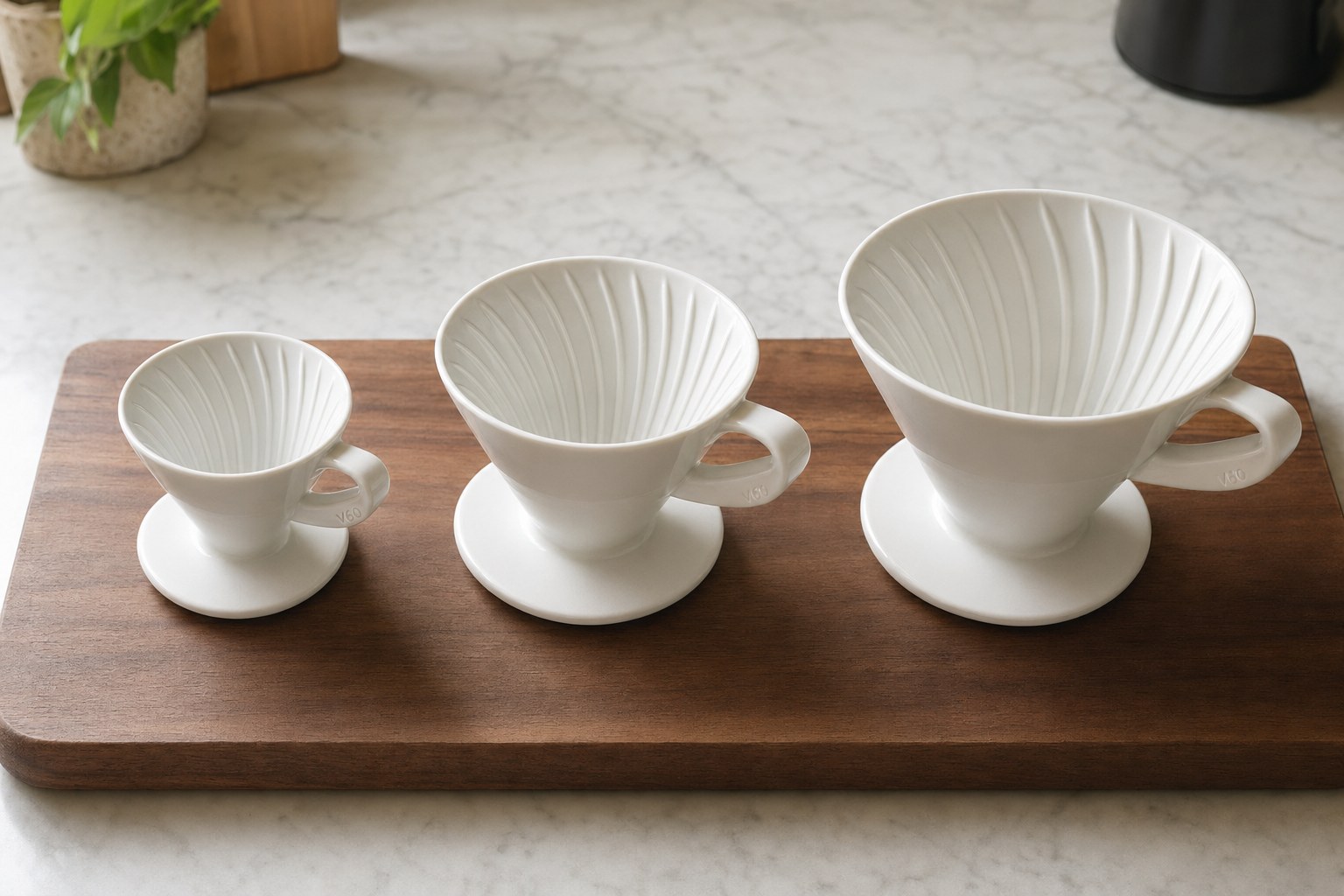
From left: V60 01 (1-2 cups), V60 02 (1-4 cups, the most common), V60 03 (up to 6 cups).
The Brewing Methods hub is the parent page for the V60 and every other brewer we cover. Our guide to different types of coffee drinks shows what each method actually produces in the cup, and the moka pot vs French press comparison covers a different brewing style entirely.
Frequently Asked Questions
What ratio should I use for my first pour over?
Start at 1:16 by weight, which is 1 g of coffee for every 16 g of water. For a 12 oz mug, that means 20 g of coffee and 320 g of water. The ratio is the variable you should change last; lock it in and adjust grind size to taste for the first five brews. Once you've made the same recipe five times, you'll have a baseline to compare new beans against. Move to 1:15 for darker roasts and 1:17 for very light single-origins.
What grind size do I need for a Hario V60?
Medium-fine, similar to table salt or slightly coarser. On a Baratza Encore, setting 18 to 22 is the right zone; on a Comandante hand grinder, 22 to 26 clicks. The drawdown time is the real test: if your brew finishes under 2:00 minutes, the grind is too coarse and the cup will taste sour and thin. If it runs longer than 3:30, the grind is too fine and the cup will taste bitter and dry. Adjust one notch at a time.
Do I really need a gooseneck kettle?
It is the single biggest upgrade after a 0.1 g scale. The narrow spout lets you control flow rate and place water exactly where you want it on the bed. A regular kettle dumps water in a wide stream that channels through the grounds, hits the filter wall, and produces uneven extraction. The Fellow Stagg EKG sets temperature in 1°F steps, but a $50 Bonavita does the same flow-control job. You can brew a serviceable cup without one; you cannot make consistent V60 pours without one.
Why do I have to rinse the paper filter?
Two reasons. Unrinsed paper adds a noticeable cardboard or papery note to your coffee, which is mostly a residue from the bleaching or unbleaching process. The rinse also preheats the dripper and the mug, which costs you about 10°F of brew temperature otherwise. Pour 200 g of hot water through the filter before you add coffee, then dump the rinse water out of the mug. The whole step takes 20 seconds and changes the cup more than it should.
How long should the brew take?
Aim for 2:30 to 3:00 from the start of your pour to the moment the last drop falls. On a V60 02 with 20 g of coffee at a 1:16 ratio, that is the window where extraction is balanced and the bed is flat. A faster brew (under 2:30) means the grind is too coarse; you'll taste sour and weak. A slower brew (over 3:30) means the grind is too fine; you'll taste bitter and dry. Time is the diagnostic tool, not the goal.
Should I buy the plastic, ceramic, or glass V60?
Plastic for taste, ceramic for looks. The plastic V60 02 has the lowest thermal mass of the three materials, which means the brew water doesn't lose heat to the dripper itself; you stay closer to your target 200°F throughout the brew. Ceramic is heavier, more breakable, and absorbs heat from the slurry, but holds temperature steady once preheated. Glass sits in the middle and is the most fragile of the three. Both plastic and ceramic make excellent coffee. The plastic is the smarter buy if you only own one.