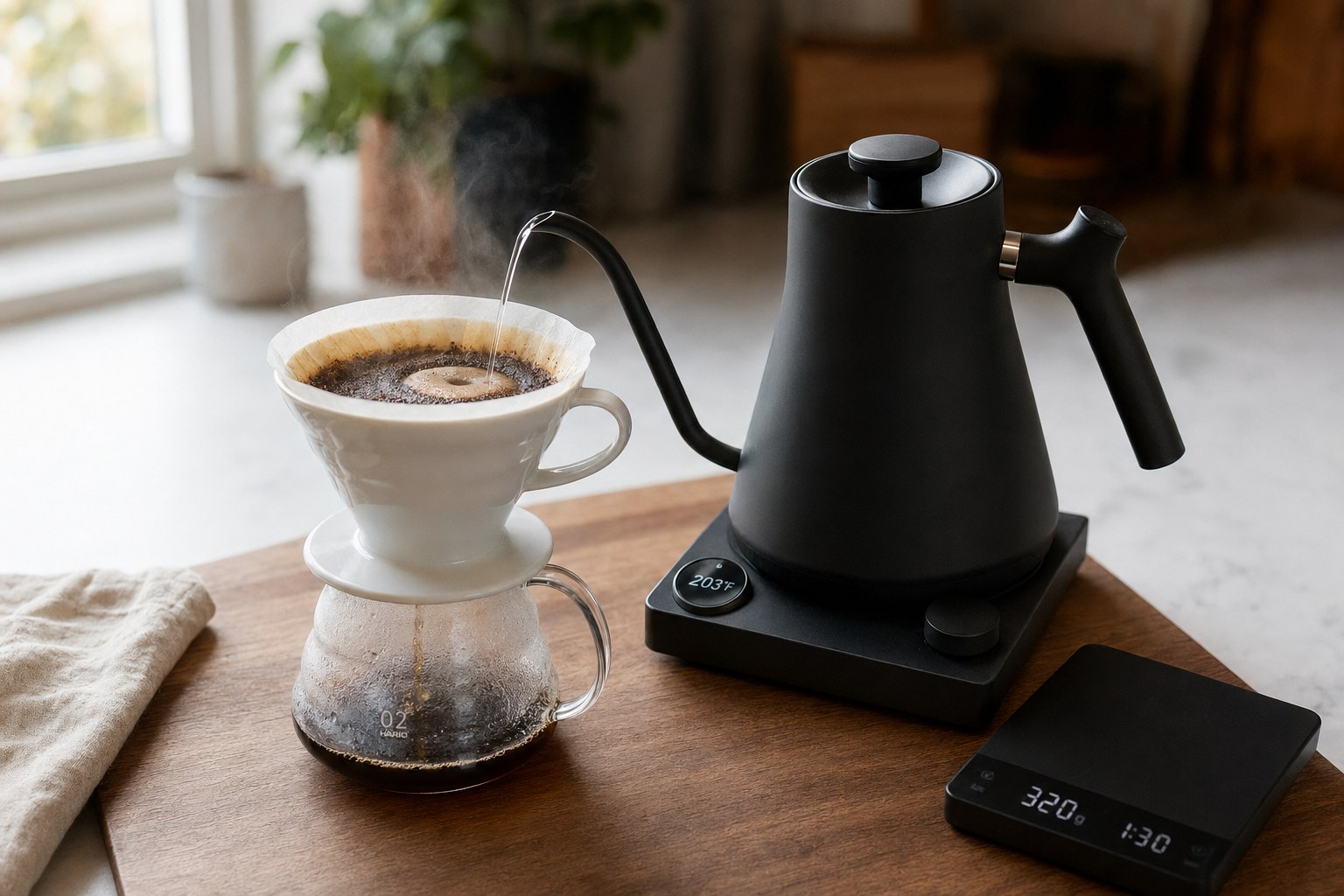
A gooseneck kettle is the most recommended pour-over coffee upgrade on the internet, which makes it worth pausing to ask: does it actually matter, and when? The answer depends entirely on which brewing method you use. For some methods it’s the highest-leverage purchase you can make. For others, it’s a beautiful kitchen ornament.
You need a gooseneck kettle for pour-over methods (Hario V60, Chemex, Kalita Wave) — you don’t need one for French press, AeroPress, drip machines, or moka pots. The narrow spout lets you pour a thin, controlled stream exactly where you want it on the bed of grounds, which is most of pour-over technique. Without one, water floods the slurry, channels form, and extraction goes uneven. For full-immersion brewers (French press, AeroPress) or machine-controlled brewers (drip coffeemakers), pouring technique doesn’t reach the grounds, so the kettle doesn’t change the cup. Budget $30 for a basic manual gooseneck (Hario Buono), $60-90 for a variable-temperature electric (Cosori, OXO), or $165-200 for a precision electric (Fellow Stagg EKG). Daily pour-over drinkers should jump straight to a variable-temp electric.
When the kettle matters (and when it doesn’t)
The shape of your brewer tells you whether the kettle matters. If the brewer relies on you to control the flow of water onto the coffee bed, a gooseneck is essential. If the brewer steeps or runs water through automatically, the kettle’s job is just transport.
| Brewing method | Kettle matters? | Why |
|---|---|---|
| Hario V60 | Yes | Bed flatness and pour rate control extraction; channeling is the #1 V60 failure mode |
| Chemex | Yes (most) | Thick filter slows drainage; a flooded slurry stays flooded for 4 minutes |
| Kalita Wave | Yes | Flat bed needs even, slow pour to avoid stalling at higher doses |
| AeroPress | No | Full-immersion steep; technique runs through the plunger, not the pour |
| French press | No | 4-minute steep makes pour speed irrelevant |
| Drip coffee maker | No | Machine controls flow; you pour into the reservoir, not the grounds |
| Moka pot | No | Pressure brewing; you add cold water to the bottom chamber |
| Cold brew | No | Long steep; pour speed has zero impact |
For the three methods where the kettle matters, what changes is the size of the change. Switching from a regular kettle to a gooseneck on a V60 is more impactful than switching beans. Switching from a regular kettle to a gooseneck on a Chemex is roughly tied with switching from supermarket coffee to specialty. Both of those are bigger gains than what most people expect from a $60-200 piece of gear.
If your daily brewer is a French press rather than a V60, see our how to use a French press guide — steep time does the work there, not pour control.
What a gooseneck actually does
Three things, in order of importance.
Restricts flow rate. A regular kettle pours roughly 300-400 mL of water in 10 seconds at a typical tilt. A gooseneck pours 100-150 mL in the same time at a similar tilt. That difference is the gap between pouring 5 g of coffee per second of contact and 12 g per second. Slower flow gives the bed time to settle and extract evenly.
Aims the stream. The narrow spout lets you direct water to within an inch of accuracy. That matters because pour-over relies on keeping the bed of grounds flat and uniformly wet. A wide-spout pour drops a stream the size of a quarter onto the slurry; the impact creates a crater, the crater creates a channel, the channel skips half the bed and over-extracts the other half.
Disturbs the slurry less. The narrow column of water displaces fewer grounds than a wide pour. Less displacement means fewer channels, fewer fines migrating to the bottom of the bed, and a more even extraction across the whole slurry.
You can sometimes work around the first two by pouring slowly and aiming carefully with a regular kettle. The third is geometry. You can’t pour a narrow stream from a wide spout no matter how careful you are.
For the gram-precision side of pour-over (which is what the kettle is enabling you to control), see our pour over coffee ratio guide for V60, Chemex, and Kalita Wave gram values.
Manual vs electric: when each makes sense
Two-thirds of the gooseneck kettle market is split between stovetop manual kettles and electric ones with built-in heating. Both work. Pick by use frequency.
Manual gooseneck kettles (Hario Buono, Bodum Melior, Coffee Gator). $25-60. You boil water on a stove or in a separate electric kettle, pour the hot water into the manual gooseneck, then pour from the gooseneck onto the coffee. The downside is temperature drift: water cools roughly 5°F in 30 seconds at room temperature, so you have to brew fast or pre-warm the manual kettle. They look beautiful and work fine for occasional pour-over.
Variable-temperature electric kettles (Cosori, OXO Brew, Bonavita). $60-90. The kettle heats and holds water at a target temperature, usually adjustable in 5-degree increments. The trade-offs vs the premium tier are usually less precise temp control (off by 2-5°F from set point) and slower heating, but the cup quality difference vs a manual is often bigger than the difference between this tier and the premium one.
Precision electric kettles (Fellow Stagg EKG, Brewista Artisan). $130-200. 1-degree precision, fast heating, hold modes, sometimes pour-over timers built in. The Fellow Stagg EKG is the most-recommended kettle in specialty coffee for a reason. It nails the temperature and looks like Apple designed it. Worth the premium if you brew daily; overkill if you make pour-over once a week.
Workarounds that almost work
If you want to brew pour-over without buying a kettle yet, two techniques get you partway there.
Lid-cracked pour. Hold a regular kettle’s lid slightly open with your thumb to disrupt the airflow that drives the pour. The water comes out in a slower, narrower stream. This works for V60 brews but is awkward and inconsistent.
Two-vessel pour. Boil water in a regular kettle, pour it into a glass measuring cup with a narrow spout (or a small saucepan with a pouring lip), then use the smaller vessel to pour onto the coffee. Better control than a wide-spout kettle but loses 5-10°F of temperature in the transfer.
Neither workaround matches a real gooseneck. If pour-over is more than an occasional brew for you, the $30-60 entry point on a manual gooseneck is the highest-leverage coffee upgrade you’ll make this year. Once you have the kettle, the how to make pour over coffee guide covers the full V60 technique step by step. For the broader kit, the Brewing Methods hub covers what each method needs, and the tablespoons of coffee per cup chart is the volumetric quick reference if you want to skip the gram scale entirely.
Frequently Asked Questions
Do you need a gooseneck kettle for pour over coffee?
For Hario V60, Chemex, and Kalita Wave, yes. A gooseneck kettle is the difference between a controlled brew and a flooded slurry. The narrow spout lets you pour a thin, steady stream exactly where you want it on the bed of grounds, which is most of the technique in pour-over. For AeroPress, French press, and drip machines, no. You don't need one because contact time is controlled by steeping or by the machine, not by your pour speed.
What does a gooseneck kettle actually do differently?
Three things. It restricts flow rate to roughly 100-150 mL per 10 seconds at a normal pour, versus 300+ mL from a wide-spout kettle. It lets you direct the stream to within an inch of accuracy, which matters for keeping the bed flat and avoiding channels in the grounds. And the narrow column of water disturbs the slurry less, which means more even extraction. Together those three change the cup noticeably more than switching beans.
Can you make pour over without a gooseneck kettle?
Yes, but the cup will usually be worse. With a regular kettle, you have two workarounds. Pour at the slowest, most controlled rate you can manage with the lid slightly open to slow the flow, or pour into a measuring cup with a spout first and then into the dripper. Both produce drinkable coffee but neither matches the flow control of a real gooseneck. If pour-over is your daily method, the kettle pays for itself in cup quality within a month.
Do you need a gooseneck kettle for a Chemex?
Yes, more than for a V60. A Chemex's thick paper filter slows drainage to 4-5 minutes, and a flooded slurry from a fast pour stays flooded for almost the entire brew. That over-extracts the bottom and leaves the top under-extracted. The Chemex was originally designed in 1941 with the assumption you'd pour from a controlled vessel; it just wasn't called a gooseneck back then.
Manual vs electric gooseneck kettle: which should I get?
Electric if you make pour-over more than three times a week. Variable-temperature electric kettles like the Fellow Stagg EKG ($165) hit your target temperature in 3-4 minutes and hold it, which means you stop guessing and start brewing. Manual kettles like the Hario Buono ($60) are cheaper and look beautiful, but you have to pull them off the stove at the right moment and pour fast before they cool. For occasional brewing, manual is fine; for daily use, electric is worth the extra money.
What temperature should the kettle be for pour over?
200°F (93°C) is the SCA-recommended target. Most variable-temperature electric kettles let you set anywhere from 100°F to 212°F in 1-degree increments. For light roasts, push to 205°F to extract more clarity. For dark roasts, drop to 195°F to avoid pulling out bitter compounds. If you have a manual kettle, bring water to a boil and let it sit 30 seconds off the heat. That's roughly 200°F.
How much should I spend on a gooseneck kettle?
$30 for a basic stovetop manual (Hario Buono, Bodum Melior). $60-90 for a variable-temperature electric without precision controls (Cosori, OXO Brew). $165-200 for a precision electric with 1-degree control and hold modes (Fellow Stagg EKG). The biggest jump in quality is from $30 to $90, paying for variable temperature. The jump from $90 to $200 buys you precision and build quality but doesn't change the cup as much as the first jump does.
Will a gooseneck kettle help with French press or drip coffee?
Not meaningfully. French press is full immersion. The water sits with the grounds for 4 minutes regardless of how you pour. Drip coffee makers control flow internally, so your pouring technique doesn't reach the grounds. The only minor benefit is more controlled water transfer into the brewer or carafe, but that's a luxury rather than a quality upgrade. Save the kettle budget for those methods and put it toward better beans or a grinder.