People with reflux usually try to fix coffee acidity by buying a bag labeled “low-acid,” paying 20 to 40 percent more, and hoping the label does the work. The chemistry tells a different story. The Puroast-funded clinical trial (Dibaise, 2003, Dig Dis Sci) put 30 coffee-sensitive subjects on Puroast vs. standard Starbucks and found no significant difference in heartburn, regurgitation, or dyspepsia. Three things you control at home, roast level, brew method, and origin, beat any specialty bag.
Dark roast Arabica from Sumatra or Brazil, brewed cold or at lower temperature, is the lowest-acid coffee you can make without buying anything new. Dark roast cuts chlorogenic acid (CGA) from about 270 mg/L in light roast to about 90 mg/L, a 66% reduction, and raises N-methylpyridinium (NMP) to about 87 mg/L vs. 29 mg/L in medium roast. NMP is the compound that actively suppresses gastric acid secretion in your stomach’s parietal cells. On the brew side, cold brew drops total titratable acids by 28 to 40 percent compared to hot brew of the same beans (Rao and Fuller, 2018, Scientific Reports). AeroPress at 175°F extracts fewer acids than standard 200°F drip. On the origin side, Sumatra (wet-hulled) and low-altitude Brazil beans are inherently less acidic than high-altitude East African coffee. Stack all three and drink with food.
Some links in this article are affiliate links. If you buy through them, we may earn a commission at no extra cost to you. We only recommend gear we’ve used or studied carefully.
Why coffee irritates your stomach, and why pH is the wrong number to watch
The compound that actually triggers stomach problems is chlorogenic acid (CGA), which stimulates the parietal cells in your stomach lining to produce more of their own acid. Coffee’s pH does not hit your stomach and burn it. Brewed coffee sits at pH 4.85 to 5.10, roughly the same as a banana. Your stomach already operates at pH 1.5 to 3.5, several orders of magnitude more acidic. Pouring a slightly acidic liquid into a far more acidic environment changes nothing. The number that matters is CGA concentration, not pH.
CGA drops sharply as you roast darker. Light roast comes in around 270 mg/L. Medium roast falls to about 187 mg/L. Dark roast lands near 90 mg/L, a 66 percent reduction from light. The same roasting process generates a second compound called N-methylpyridinium (NMP), which works in the opposite direction. Dark roast contains roughly 87 mg/L of NMP vs. about 29 mg/L in medium-roast blends. NMP down-regulates parietal cell acid secretion, so you get a double benefit from going darker: less CGA stimulating acid output, more NMP suppressing it.
Cold brew works through a different mechanism. The pH gap between cold brew and hot brew is small, only 0.2 to 0.34 units, which is why “low-acid” pH marketing is misleading. The real difference is total titratable acid load, which drops 28 to 40 percent in cold brew (Rao and Fuller, 2018). Same beans, same roast, fewer total acidic compounds extracted. Don’t confuse the two numbers.
Lever 1: Roast level (the biggest single change you can make)
Going darker does more than any other change you can make at home. CGA falls from 270 mg/L (light) to 187 mg/L (medium) to 90 mg/L (dark). NMP rises from about 29 mg/L in medium-roast blends to 87 mg/L in dark roast. Rubach et al. (2014, Mol Nutr Food Res) is the only clinical study that measured this directly: dark roast triggered significantly less gastric acid secretion than medium or light roast in test subjects. That is a clinical outcome on actual stomachs, not a pH meter reading.
Medium roast is not a meaningful middle ground. CGA is still around 187 mg/L, only a 31 percent drop from light. NMP stays low. If your goal is stomach comfort, medium roast splits the difference on flavor without splitting the difference on the chemistry that matters.
We compared the full flavor, caffeine, and acidity profiles in our light roast vs. dark roast comparison.
- 66% CGA reduction vs. light roast (270 mg/L to 90 mg/L)
- NMP rises to about 87 mg/L, actively suppressing gastric acid secretion
- Clinical confirmation from Rubach 2014 on actual stomach acid output
- No equipment change needed, works with any brewer you own
- Loses origin-specific brightness (fruit notes, floral character, terroir)
- Risk of roasty or charred bitterness if pushed past dark into burnt
- Caffeine still relaxes the lower esophageal sphincter for some drinkers
- Reduces acid load but does not eliminate it
Look for full city plus or French roast designations from a roaster who knows what they’re doing. Dark and burnt are not the same thing.
Lever 2: Brew method (cold brew and AeroPress change the math)
Cold brew is the biggest non-roast lever you have. Rao and Fuller (2018, Scientific Reports) measured 28 to 40 percent fewer total titratable acids in cold brew vs. hot brew of the same beans. Rao, Fuller, and Grim (2020, Foods) confirmed the result and added that the effect holds at every roast level. Dark roast cold brew compounds both reductions and lands at the lowest titratable acidity of any standard brew combination.
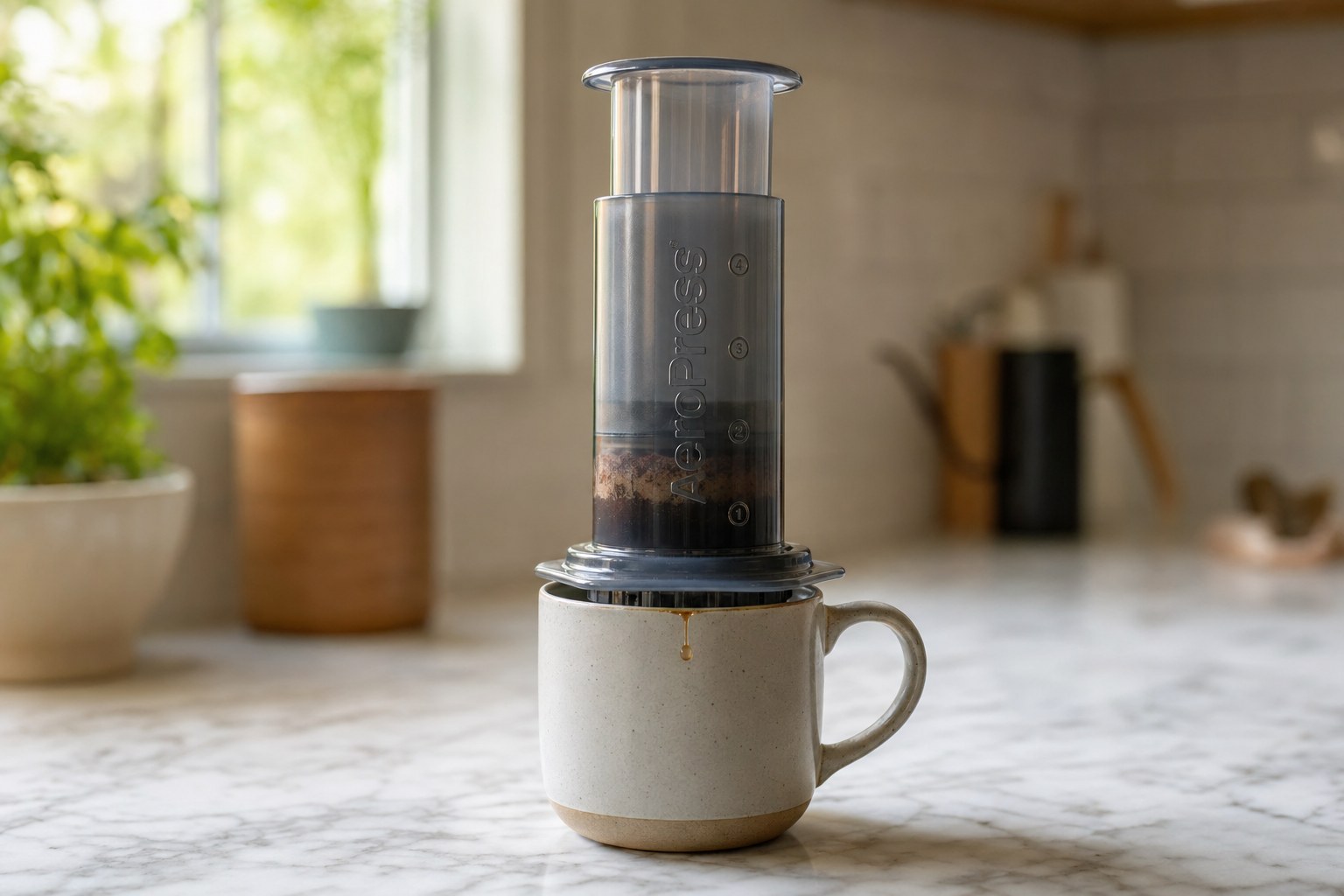
The AeroPress Original ($39.95) lands second. Brewing at 175 to 185°F instead of standard 200°F extracts fewer acids because acid solubility scales with temperature. The pressure-assisted extraction also keeps total brew time short, which limits how much acid leaches into the cup. AeroPress claims one-fifth the acidity of drip and one-ninth the acidity of French press. Treat those numbers as a manufacturer claim with no independent peer review, but the temperature-and-time science supports the direction.
The Bodum Chambord French press ($40) sits in the middle. Full immersion extraction at moderate temperature plus a metal filter that lets coffee oils pass through both reduce perceived sharpness. Paper filters strip those oils; metal filters do not. Less perceived acid, fuller body. We put the French press and moka pot head-to-head in our moka pot vs. French press comparison.
The contrast case is the Hario V60. Percolation through a paper filter at 195 to 205°F is the most acidic common home method. The V60 is built for flavor clarity and bright origin character, which is the opposite of what a sensitive stomach wants. If you love your V60, our pour-over ratio guide shows how to dial in the cleanest possible extraction so you are not over-pulling acid on top of an already acidic method.
| Method | Relative Acidity | Why | Best For |
|---|---|---|---|
| Cold brew | Lowest | 28–40% fewer titratable acids (Rao 2018) | GERD; dark roast concentrate |
| AeroPress at 175°F | Very Low | Lower temp extracts fewer acids | Light roast lovers with stomach issues |
| French press | Low | Immersion plus metal filter passes buffering oils | Everyday drinkers wanting full body |
| Auto-drip | Moderate | Paper filter, ~200°F standard extraction | Most home setups |
| Pour-over (Hario V60) | Higher | High-temp percolation plus paper filter | Flavor clarity, origin brightness |
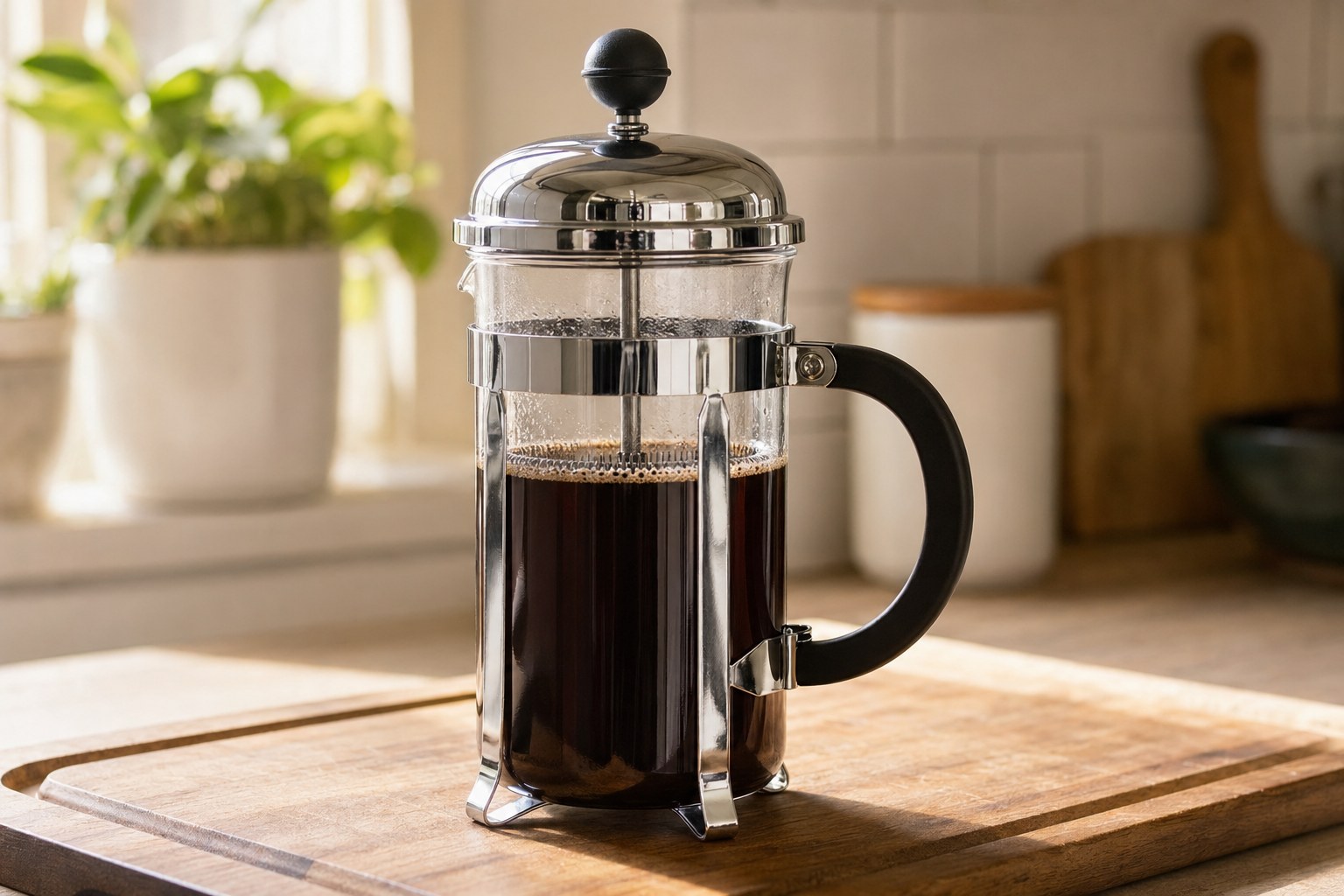
The Bodum Chambord’s metal mesh filter passes coffee oils into the cup, which buffers perceived acidity compared to paper-filtered methods.
Lever 3: Where the bean grew (helpful, but the weakest of the three)
Sumatra Mandheling is the most reliable low-acid origin on the planet. Two factors compound. First, the beans grow at 750 to 1,500 meters, which is moderate altitude rather than the 1,800-plus meters where bright organic acids develop most aggressively. Second, the wet-hulling process called Giling Basah, where beans are hulled at roughly 35 percent moisture, mutes the fruity acidity typical of Arabica. The result is heavy body, earthy depth, and low perceived acidity. Mandheling is almost always sold as a dark roast, which automatically combines two of the three levers in this guide. Volcanica’s Sumatra Mandheling at about $22 per bag is a solid example.
Brazil’s Cerrado region in Minas Gerais is the easier-to-find option. Coffee grown at 800 to 1,300 meters in a warm climate, processed naturally, produces a smooth, chocolatey, nutty cup with low inherent acidity. Brazilian beans show up in supermarkets and grocery store coffee aisles in a way Sumatra does not.
The contrast is bright origin coffee. Take a high-grown Ethiopian Yirgacheffe or Kenyan AA at 1,500 to 2,200 meters, roast it light, and brew it on a V60. That is the worst case for a sensitive stomach. Sensory acidity rises by roughly 0.22 cupping points per 100 meters of elevation gain, and high-altitude beans are usually paired with light roasts that preserve that brightness.
Origin alone will not fix a light-roast acidity problem. This is the smallest of the three levers. Pair origin with roast level for it to matter.
How to stack the levers (and the truth about “low-acid” coffee brands)
The combination that produces the lowest-acid cup achievable at home is dark roast Sumatra or Brazil beans, brewed cold or via AeroPress at 175°F, drunk with food. Each lever is documented in peer-reviewed research. Stacked, they compound.
Brand “low-acid” coffee is mostly a packaging story. The Puroast-funded clinical trial (Dibaise JK, 2003, Dig Dis Sci) enrolled 30 coffee-sensitive subjects in a crossover design and found no significant difference in heartburn, regurgitation, or dyspepsia between Puroast “low-acid” coffee and standard Starbucks. The benefits Puroast does deliver are attributable to its dark roast level and processing choices that any dark roast already provides. You are paying a 20 to 40 percent premium for advantages you can replicate with a $12 bag from a local roaster.
If you cannot give up light roast, the AeroPress at 175 to 180°F gets you the closest. Pair it with moderately alkaline brew water. Scott Rao recommends 30 to 40 ppm alkalinity for light roasts because alkalinity buffers coffee acid in the cup, and the SCA’s Dr. Wellinger notes that alkalinity has “several hundredfold” more impact on final cup acidity than pH does. If your tap water is filtered to RO levels or naturally soft, the same beans will taste sharper than they need to. A mineral packet like Third Wave Water adjusts soft or RO water into the useful range and costs about a dollar per gallon brewed.
One free lever almost no one uses: never drink coffee on an empty stomach. Food in your stomach buffers gastric acid production regardless of which roast or method you chose. The Cleveland Clinic’s coffee-and-reflux guidance (Czerwony, 2026) opens with this rule for a reason.
Frequently Asked Questions
What type of coffee has the least acid?
Dark roast Arabica from a low-altitude origin (Sumatra Mandheling or Brazilian Cerrado), brewed as cold brew or in an AeroPress at 175°F, is the least acidic coffee you can make at home. Dark roasting cuts chlorogenic acid by 66 percent vs. light roast and raises NMP, which suppresses gastric acid. Cold brew further reduces total titratable acids by 28 to 40 percent.
Is dark roast less acidic than light roast?
Yes, meaningfully. Dark roast contains about 90 mg/L CGA vs. about 270 mg/L in light roast, and 87 mg/L NMP vs. 29 mg/L in medium-roast blends. CGA stimulates gastric acid; NMP suppresses it. The clinical study from Rubach et al. (2014, Mol Nutr Food Res) confirmed dark roast triggers significantly less gastric acid secretion than medium or light roast. The pH gap is only about 0.4 units, so pH alone misrepresents the difference.
Is cold brew less acidic than hot coffee?
By titratable acid load, yes, by 28 to 40 percent. By pH, barely (0.2 to 0.34 units). The two numbers measure different things. pH counts hydrogen ion concentration. Titratable acidity counts the total load of acidic compounds in the cup, which is what affects your stomach. Cold extraction temperature dissolves fewer melanoidin-bound acids, lowering total acid load (Rao and Fuller, 2018, Scientific Reports).
What coffee is best for GERD?
The Cleveland Clinic (2026) recommends dark roast, paper-filtered or cold-brewed, ideally espresso or cold brew. Combined with the chemistry research, the strongest combination is a dark roast Arabica from Sumatra or Brazil, brewed cold or via AeroPress at 175°F, drunk with food, capped at two to three cups per day. Branded low-acid coffees did not outperform standard coffee in the Puroast-funded clinical trial. If symptoms persist multiple times per week, see a gastroenterologist.
Is decaf coffee less acidic?
Slightly. Decaf measures around pH 5.0 vs. about pH 4.7 for regular, a small difference, and CGA levels are similar. The bigger reflux benefit is removing caffeine itself, which relaxes the lower esophageal sphincter and lets stomach acid back up. If caffeine is your specific trigger, decaf dark roast brewed cold is worth trying. If your trigger is CGA-stimulated stomach acid, decaffeination alone will not solve the problem.
What origin or country produces the least acidic coffee?
Brazil and Indonesia, especially Sumatra. Brazil's Cerrado grows coffee at 800 to 1,300 meters in a warm climate, producing smooth, chocolatey, low-acid beans. Sumatra Mandheling combines moderate altitude with the Giling Basah wet-hulling process, which mutes Arabica's natural fruity acidity. Vietnam produces low-acid Robusta at low altitude, though Robusta is rarely used in specialty brewing. High-altitude origins such as Kenya and Ethiopia at 1,800 meters plus produce brighter, more acidic beans.