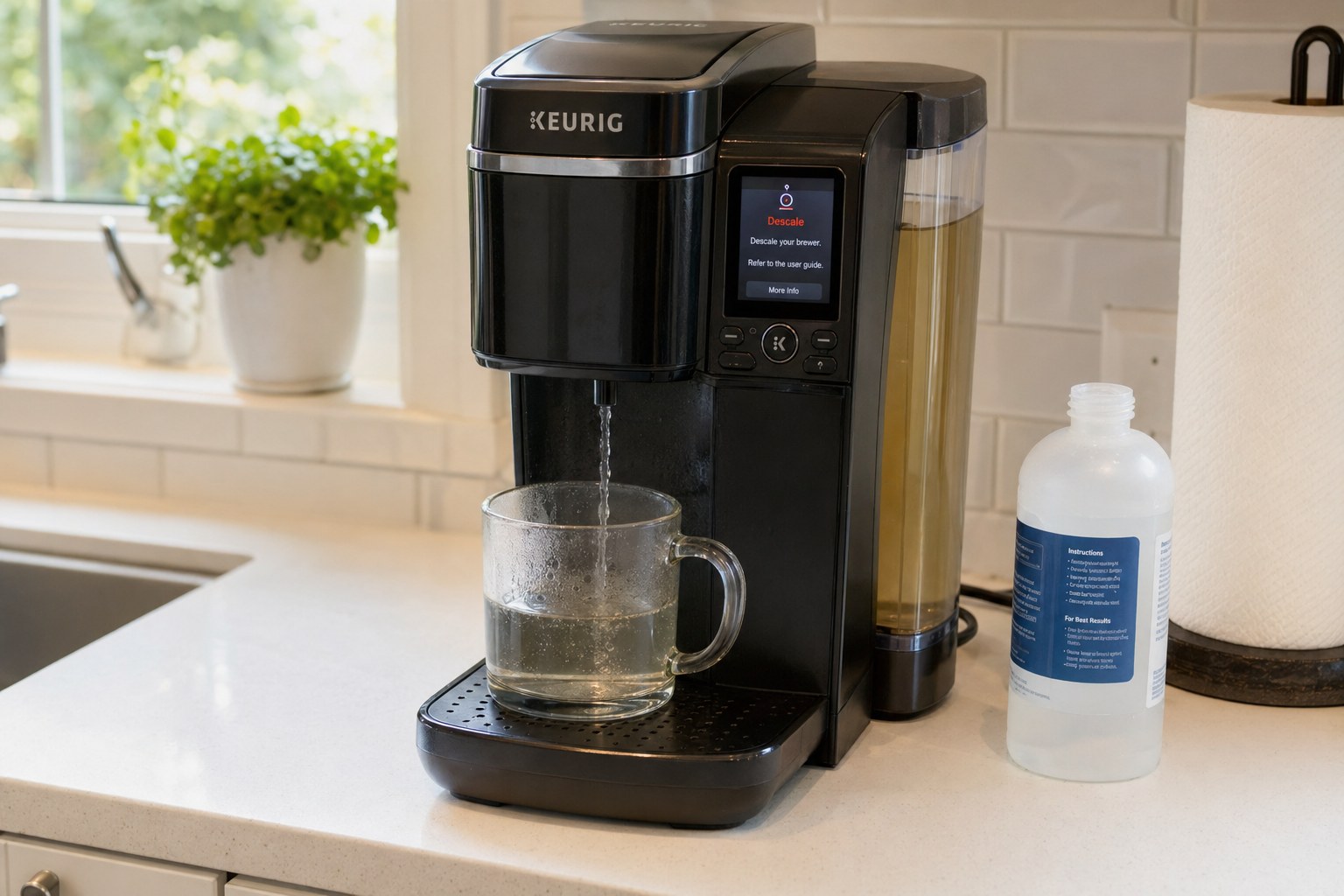
If your Keurig is taking forever to brew, the coffee comes out lukewarm, or the descale light is glowing at you, your brewer is full of limescale and it’s time to clean it out. Descaling is a 45-minute job with no skill required, just patience during the rest period. This guide walks every step with timing, plus the model-specific button combo to reset the descale light when you’re done.
To descale a Keurig: empty the reservoir, fill it halfway with descaling solution and halfway with water (or 1:1 white vinegar and water), then run cleaning-only brews until the reservoir is empty. Wait 30 minutes (4 hours for vinegar). Refill with fresh water and run at least 4 rinse cycles. Total time: about 45 minutes with descaling solution, 5 hours with vinegar. To clear the descale light on K-Elite, K-Supreme, K-Duo, and K-Slim, hold the 8 oz and 10 oz buttons together for 3 to 5 seconds. The K-Classic clears on its own. Keurig recommends descaling every 3 to 6 months — every 3 if your tap water is hard.
Before you start: what you’ll need
Three things: a descaling agent, an empty mug, and 45 minutes (or 5 hours if you go the vinegar route).
- Descaling agent. One bottle of Keurig Descaling Solution, one packet of Urnex Dezcal, or 16 oz of plain white vinegar (5% acidity).
- A large mug or measuring cup. At least 12 oz capacity. You’ll be dumping the contents repeatedly into the sink.
- Fresh water. Filtered is fine; distilled is better for the rinse cycles since it adds no new minerals.
Lift the handle, remove any K-Cup that’s in there, dump the existing water out of the reservoir, and pull out the water filter cartridge if your model has one (K-Elite, K-Supreme, K-Duo). The filter shouldn’t be in the path during descaling.
This guide works for every Keurig home brewer: K-Classic, K-Mini, K-Elite, K-Supreme, K-Duo, K-Slim, K-Compact, and K-Cafe. The reset-light button combo varies by model and is in its own section below.
How to descale a Keurig step by step
The example below uses Keurig Descaling Solution. If you’re using vinegar, the steps are identical but the rest period is 4 hours instead of 30 minutes, and you’ll need 12 rinse cycles instead of 4.
Step 1: Power off and prep (2 minutes). Power the brewer on. Lift the handle to make sure no K-Cup is loaded. Empty the reservoir into the sink. If your model has a charcoal water filter (K-Elite, K-Supreme, K-Duo), remove it and set it aside. The filter must not be in the brewer during descaling.
Step 2: Add the descaling agent (1 minute). Pour an entire bottle of Keurig Descaling Solution into the empty reservoir. Refill the empty bottle with fresh water and pour that in too. The reservoir should be roughly 32 oz of 1:1 solution. For vinegar, fill the reservoir half with white vinegar, half with water, up to the max line.
Step 3: Run the first cleaning brew (1 minute). Place a large empty mug on the drip tray. Lift the handle, leave the K-Cup chamber empty, lower the handle. Press the largest brew size (10 oz or 12 oz) and start a cycle. The brewer will dispense hot solution into the mug. Empty the mug into the sink.
Step 4: Repeat until the reservoir is empty (10 to 12 minutes). Keep running cleaning brews back to back, emptying the mug each time, until the “Add Water” indicator lights up. Most reservoirs run about 4 to 6 cycles before they’re empty. You’re flushing solution through every internal water path while doing this.
Step 5: Wait the rest period (30 minutes for solution, 4 hours for vinegar). Leave the brewer powered on. Don’t refill the reservoir. The descaling agent that’s still inside the brewer is dissolving limescale during this time. Set a timer. Don’t skip this step. It’s the part that actually does the work.
Step 6: Run rinse cycles with fresh water (10 to 15 minutes). Fill the reservoir to the max line with fresh, filtered or distilled water. Run a full 10 oz cycle into the empty mug. Empty the mug. Repeat at least 4 times for descaling solution, 12 times for vinegar. If you can still smell vinegar after 12 cycles, do a few more.
Step 7: Reset the descale light (1 minute). On K-Elite, K-Supreme, K-Duo, K-Slim, and K-Compact, hold the 8 oz and 10 oz buttons together for 3 to 5 seconds while the brewer is idle. The descale light turns off. K-Classic and K-Mini clear automatically once the rinse cycles complete.
Step 8: Reinstall the filter and brew a regular cup. Replace the charcoal water filter cartridge if you removed one. Refill the reservoir with normal water. Run one final 10 oz cycle into the sink to confirm the water tastes neutral. You’re back to normal coffee.
Descaling solution vs vinegar: which to use
Both methods work. The choice comes down to time, smell, and what’s in the cabinet.
| Factor | Descaling solution | White vinegar (5%) |
|---|---|---|
| Active ingredient | Citric acid | Acetic acid |
| Total time | ~45 minutes | ~5 hours |
| Rest period | 30 minutes | 4 hours |
| Rinse cycles needed | 4 minimum | 12 minimum |
| Cost per descale | $5-10 | $1-2 |
| Lingering smell | Minimal | Strong (rinses to clear) |
| Officially endorsed by Keurig | Yes | No |
| Best for | Convenience, taste-sensitive users | Cost, infrequent descaling |
If you descale on schedule (every 3 to 6 months), the descaling solution is worth the few extra dollars. You save 4 hours of waiting and avoid the vinegar smell. If you’ve gone a year between descales and there’s heavy buildup, run vinegar first for the deeper clean, then a solution cycle a week later to get any residual scale and remove the vinegar taste.
Keurig’s official position is that vinegar is “not recommended” but won’t void the warranty. The acid is gentle enough for the food-grade plastic in the reservoir. Avoid bleach, lemon juice (too weak to do anything useful), and CLR or other industrial descalers (too aggressive).
How to reset the descale light by model
| Model | Reset method |
|---|---|
| K-Classic, K-Mini | No manual reset; clears automatically after rinse cycles |
| K-Elite | Hold 8 oz + 10 oz buttons for 3-5 seconds (idle, not brewing) |
| K-Supreme, K-Supreme Plus | Hold 8 oz + 10 oz buttons for 3-5 seconds |
| K-Duo, K-Duo Essentials | Hold 8 oz + 10 oz buttons for 3-5 seconds |
| K-Slim, K-Compact | Hold 8 oz + 10 oz buttons for 3-5 seconds |
| K-Cafe | Hold the espresso shot button + the 8 oz button for 3-5 seconds |
If the light comes back on within 24 hours, the scale wasn’t fully cleared. Run the whole process again. Most often that means you skipped the 30-minute rest period or you only did 1 or 2 cleaning cycles instead of running until the reservoir was empty.
If the light won’t turn off at all even after a complete second descaling, check the float sensor in the bottom of the reservoir. Pull the reservoir off, rinse the bottom, make sure the float (a small white disc) moves freely, and reseat the reservoir firmly. Loose-seated reservoirs sometimes confuse the brewer’s level sensor and trigger the wrong indicator.
How often to descale (and how to tell)
Keurig recommends descaling every 3 to 6 months. The 3-month end of the range is for hard-water households (over 7 grains per gallon, which covers most of the Midwest, Southwest, Florida, and Texas). Soft-water and filtered-water households can usually go 6 months. Daily users at 4+ cups should also lean toward 3 months regardless of water hardness.
You don’t have to wait for the descale light. Three earlier signals tell you the brewer is overdue:
- Brew time has crept up by 30 seconds or more compared to when the brewer was new
- Coffee comes out lukewarm instead of hot, because limescale insulates the heating element
- The brewer makes a sputtering or gurgling sound during the cycle, sometimes spitting water back into the reservoir
If any of those show up before the descale light, run a cycle anyway. The scale builds up gradually inside the heater and water lines, and waiting until the brewer detects it is waiting longer than necessary.
For broader maintenance context, our pour over coffee ratio guide covers the brew variables that matter most after the brewer itself is clean. The Brewing Methods hub is the parent page for our brewing-method comparisons, including moka pot vs French press for readers thinking about life beyond the Keurig.
Frequently Asked Questions
How often should you descale a Keurig?
Keurig recommends descaling every 3 to 6 months, or whenever the descale light comes on. If you have hard tap water, lean toward every 3 months. With softened or filtered water, every 6 months is usually fine. Heavy users (more than 4 cups a day) should descale at the shorter end of the range too. Skipping it leads to slower brews, lukewarm coffee, and eventually a clogged needle that won't dispense water at all.
Can I descale my Keurig with vinegar?
Yes. White vinegar works because it's about 5% acetic acid, which dissolves limescale the same way commercial descaling solutions do. The trade-off is a much longer rest period (about 4 hours versus 30 minutes for solution) and at least 12 rinse cycles to remove the smell. Use a 1:1 mix of white vinegar and water, fill the reservoir to the max line, then run cleaning brews until the reservoir is empty.
How do I reset the descale light on my Keurig?
On the K-Elite, K-Supreme, K-Duo, and K-Slim, hold the 8 oz and 10 oz buttons together for 3 to 5 seconds while the brewer is on but idle. The descale light will turn off. The K-Classic doesn't have a manual reset. Once you finish the rinse cycles, the light clears on its own. If your light comes back on within a day, the descaling didn't fully clear the scale. Run a second cycle.
What if my Keurig descale light won't turn off?
Two causes. Either the descaling didn't break down all the limescale (run a second full cycle), or you skipped the rinse cycles and the brewer still detects descaling solution in the water path. Run 4 to 12 fresh-water rinse cycles. If the light still won't clear after a complete second descaling, the float sensor in the reservoir may be stuck. Remove the reservoir, rinse it, and replace it firmly seated.
How long does it take to descale a Keurig?
Plan on 45 minutes to 1 hour total with the descaling solution. About 5 minutes of active work, then a 30-minute rest period, then 10 to 15 minutes of rinse cycles. With vinegar, plan on 5 hours total because of the longer 4-hour rest period and additional rinses needed to remove the smell. Don't try to rush the rest period. That's when the acid actually breaks down the scale.
Do I have to use Keurig brand descaling solution?
No. Any citric-acid-based descaler works the same way as Keurig's. Urnex Dezcal is the most common alternative and is sold in 8-pack single-use packets that fit one descale cycle each. Affresh and Impresa Products also make compatible descalers. White vinegar is the cheapest option but takes longer and needs more rinses. Avoid bleach, lemon juice (too weak), or CLR (too aggressive for the food-grade plastic in the reservoir).
Can I run a K-Cup during the descaling cycle?
No. Lift the handle and remove any K-Cup before starting. Descaling solution and hot water flow straight through the brewer without coffee in the path. Running a pod would just waste a K-Cup and contaminate the descaling solution. Replace the K-Cup only after you've finished both the descaling cycles and at least 4 fresh-water rinse cycles.
Why does my Keurig still taste funny after descaling?
You probably need more rinse cycles. Both descaling solution and vinegar leave residual flavor in the brewer's water path. Run a minimum of 4 rinse cycles with fresh water, more if you used vinegar (12 is typical). Also rinse the reservoir, water filter housing, and drip tray with warm soapy water. If the off-taste persists after 12 rinses, there's still scale in the system and you need a second descale cycle.